Highlights
- By Peush Bery, Xtreme Gen AI
- Highlights
- 1. What exact admissions outcome are you buying?
- 2. Does the Voice AI Agent fit the admissions architecture?
- 3. How will consent, calling preferences and learner data be handled?
- 4. Can the system use only approved course information?
- 5. Does regional-language performance survive real admissions calls?
- 6. What exactly triggers human handoff?
- 7. How will the vendor govern, test and monitor production risk?
- 8. Are the commercial terms aligned with admissions value?
- A practical CEO decision rule
- Where Xtreme Gen AI fits
- Conclusion

What CEOs Should Ask Before Buying Voice AI for Admissions
By Peush Bery
Published: June 25, 2026
By Peush Bery, Xtreme Gen AI
Buying Voice AI for admissions can look deceptively simple. A vendor demonstrates a fluent call, the agent answers a few course questions, and the conversation sounds natural. For a CEO or founder, however, the decision is not whether one call sounds impressive. The decision is whether the system can improve admissions operations without creating new compliance, data, customer-experience, or reporting problems.
A real education funnel includes leads from ads, landing pages, webinars, partner lists, missed calls, WhatsApp, referrals, and old CRM databases. Those leads may ask about different programmes, fees, eligibility, schedule, placement support, online recognition, regional-language counselling, or parent involvement. The Voice AI Agent has to work across that messiness while respecting calling rules and handing judgement-heavy conversations to counsellors.
This CEO checklist for admissions Voice AI is designed around production readiness. It examines the commercial outcome, workflow architecture, data and consent controls, regional-language quality, human handoff, monitoring, and vendor accountability that should be clear before a contract is signed.
Highlights
What CEOs and founders should establish before signing
- A natural-sounding demo is evidence of conversation quality, not production readiness.
- The buying decision should begin with a defined admissions outcome such as faster qualification, cleaner counsellor queues, missed-call recovery, or dormant-lead reactivation.
- The Voice AI Agent must create CRM actions and next steps, not only transcripts.
- CEOs should require clarity on data access, consent, opt-outs, retention, recordings, and vendor responsibilities.
- Regional-language support must be tested with real course names, city names, fee terms, interruptions, and code-switching.
- Human handoff needs routing rules, context transfer, fallback behaviour, and measurable completion.
- The vendor should expose operational metrics, failure modes, change controls, and ownership after launch.
- Commercial evaluation should use cost per qualified or progressed lead, not only per-minute calling price.
1. What exact admissions outcome are you buying?
The first question is not what the AI can say. It is what business outcome the organisation wants to change. One company may need instant first response for paid leads. Another may need qualification before counsellors call. A third may need webinar follow-up, dormant-lead reactivation, fee-stage callbacks, or missed-call recovery. These are different workflows with different data, scripts, integrations, and success metrics.
A broad promise such as “automate admissions calls” is too weak for procurement. The CEO should ask the vendor to define the starting event, the target lead segment, the questions the Voice AI Agent will ask, the systems it will read, the actions it will write, and the point at which a human takes over. If those details cannot be written as a workflow, the project is still a demo idea.
The expected outcome should also be measurable. Useful goals include median speed-to-first-call, valid connection rate, qualified-lead rate, counsellor callback completion, CRM-field completeness, WhatsApp follow-up success, appointment or counselling booking rate, and enrolment progression. Call count and total minutes are operating statistics, not business outcomes.
2. Does the Voice AI Agent fit the admissions architecture?
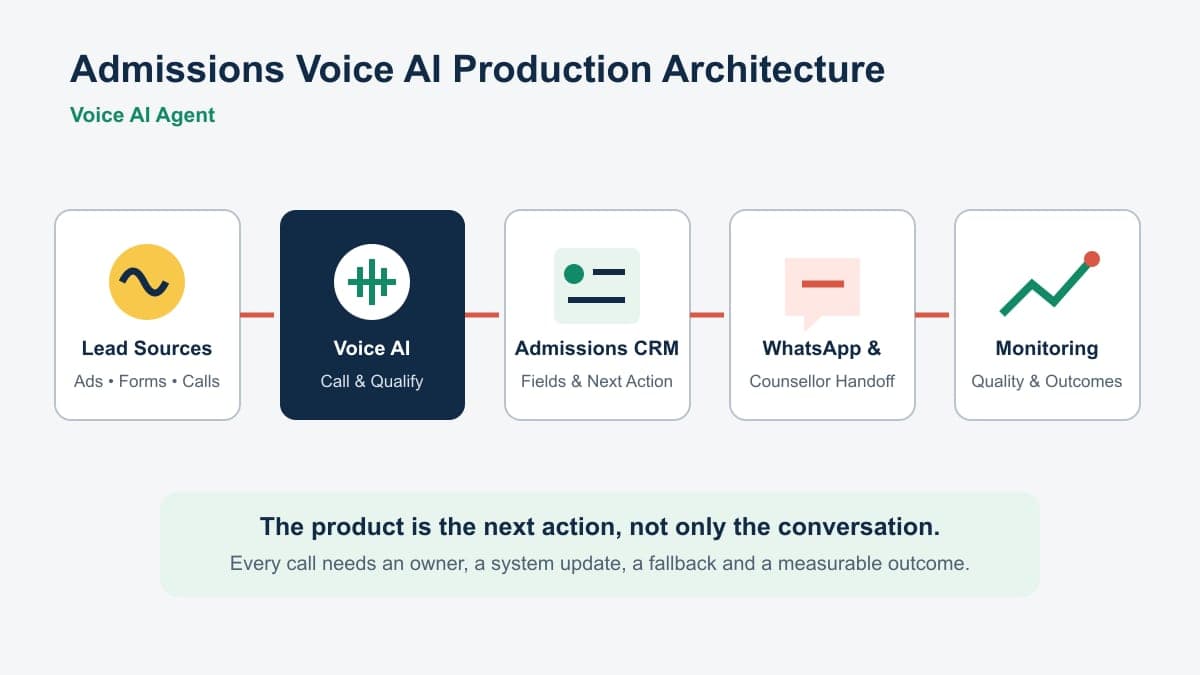
Voice AI for course admissions sits between telephony, lead sources, the admissions CRM, programme information, counsellor queues, callback scheduling, WhatsApp, and reporting. The vendor should show how each connection works. A slide with logos is not an integration design. CEOs should ask which system is the source of truth, what happens in real time, what is asynchronous, and how failures are retried.
Before the call, the agent may need campaign source, course interest, previous attempts, city, preferred language, lead owner, eligibility rules, and permitted calling window. After the call, it should return structured fields such as course intent, learner profile, budget or fee concern, timeline, parent involvement, preferred callback, WhatsApp action, lead score, disposition, and handoff reason.
The transcript is useful for quality review, but it is not the product. The operational product is the next action: update the record, send approved information, schedule a counsellor, retry at the right time, suppress an opt-out, or close the lead with a clear reason.
3. How will consent, calling preferences and learner data be handled?
Admissions teams work with personal data: names, phone numbers, education background, location, programme interest, call recordings, and sometimes financial or family context. The Digital Personal Data Protection Act, 2023 establishes responsibilities around processing digital personal data. Its consent provisions describe consent as free, specific, informed, unconditional and unambiguous, given through clear affirmative action, and it requires withdrawal to be as easy as giving consent.
TRAI's commercial-communication framework also makes customer preference, consent and accountable sending important. The precise operational and legal interpretation should be validated by the organisation's counsel and telecom partners, but a vendor should still be able to explain how it uses approved lead sources, calling windows, opt-out signals, suppression lists, sender registration, and campaign records.
The CEO should ask who acts as data processor or service provider, where recordings and transcripts are stored, how long they are retained, who can access them, how deletion requests are handled, and whether customer data is used to train shared models. The safest architecture minimises the data given to the agent and keeps permissions tied to the task.
4. Can the system use only approved course information?
Education calls are not generic sales conversations. Learners ask about eligibility, recognition, curriculum, faculty, assessment, fees, refund rules, placement support, batch dates, and learning mode. If the agent improvises, an apparently confident answer can become a serious trust problem. The system should answer only from approved, version-controlled programme information and should expose where that information came from.
UGC's regulations for online and open-distance programmes emphasise structured programme delivery, learner support, and institutional responsibilities. A Voice AI Agent should not reinterpret regulation or make recognition claims by inference. Questions involving exceptions, academic equivalence, scholarship decisions, refunds, or career suitability should move to an authorised human.
Ask how business teams update programme facts, how quickly a changed fee or batch date becomes available, how old information is retired, and what the agent says when the answer is missing. “I will arrange a counsellor callback” is often a better production response than a plausible but unverified answer.
5. Does regional-language performance survive real admissions calls?
A claim of multilingual support is not enough. Indian admissions conversations frequently combine a regional language with English course names, technology terms, university names, fee amounts, dates, and city names. Parents and learners may interrupt, change language, speak from noisy locations, or give partial answers. The system must be tested against the organisation's actual leads rather than a studio script.
A practical pilot should include the languages required by the campaign geography, not an arbitrary Hindi-English limit. It should test pronunciation, code-switching, number confirmation, names, course vocabulary, silence, repeated questions, and low-quality mobile audio. Performance should be reviewed separately by language because one aggregate connection metric can hide weak experiences.
The vendor should also explain what happens when language detection is uncertain. The agent may need to ask for preference, switch safely, or route to a counsellor. An admissions call should never become a test of whether the learner can adapt to the system.
6. What exactly triggers human handoff?
The strongest model is Voice AI before counsellor, not Voice AI instead of counsellor. The agent can make first contact, qualify intent, capture structured context, send approved material, and schedule the next conversation. Counsellors should own programme fit, persuasion, parent reassurance, fee negotiation, scholarship nuance, complex eligibility, complaints, and final enrolment closure.
Ask the vendor to list handoff triggers explicitly. These may include high purchase intent, a request for a person, repeated misunderstanding, negative sentiment, a policy exception, an unsupported question, a payment issue, or a safety and compliance boundary. The transfer should carry the lead record and a short summary so the learner does not have to repeat the entire conversation.
Transfer failure also needs a workflow. If no counsellor answers, the system should offer a scheduled callback, update the CRM, notify the owner, and send an appropriate acknowledgement. A successful handoff metric should mean that the human interaction happened, not merely that the AI attempted a transfer.
7. How will the vendor govern, test and monitor production risk?
NIST's AI Risk Management Framework organises risk work around four functions: Govern, Map, Measure and Manage. That is a useful buying lens. Governance covers ownership and policy. Mapping covers the admissions context and affected users. Measurement covers quality, errors and business performance. Management covers how the team responds when the system fails or the workflow changes.
The CEO should ask who approves scripts, who can change prompts and rules, how releases are tested, how sample calls are reviewed, and how incidents are escalated. Monitoring should include latency, dropped calls, failed tool actions, incorrect dispositions, transfer failure, WhatsApp failure, language-level quality, opt-outs, human corrections, and CRM reconciliation.
Production ownership matters after launch. Admissions campaigns change weekly. New programmes open, fees move, counsellor rosters change, and campaign sources appear. A vendor that requires a long engineering cycle for every business update can become an operational bottleneck even if the voice quality is excellent.
8. Are the commercial terms aligned with admissions value?
Per-minute price is easy to compare, but it can produce the wrong decision. A cheaper call that creates incomplete CRM data, weak qualification, or failed handoffs is not cheaper for the admissions operation. CEOs should compare cost per connected lead, cost per qualified lead, cost per completed counselling booking, and cost per progressed application alongside counsellor hours saved.
Commercial review should also cover telephony charges, language pricing, integration work, support, monitoring, change requests, minimum commitments, concurrency, retry volume, data export, and exit terms. The organisation should be able to retrieve its lead data, call outcomes, recordings, and workflow configuration in a usable format.
A sensible pilot uses a defined segment and baseline. Compare the Voice AI workflow with the previous process using the same outcome definitions. Do not declare success because the agent completed many calls. Success means that the admissions funnel became faster, cleaner, more measurable, or more productive without weakening learner trust.
A practical CEO decision rule
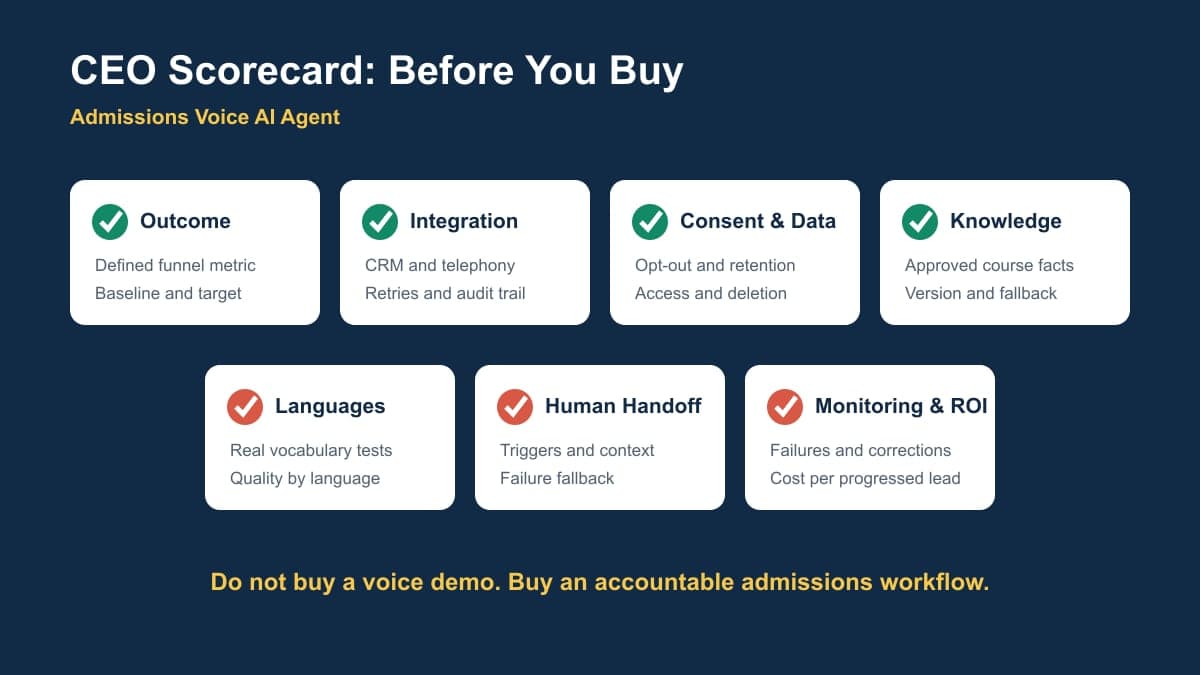
A Voice AI vendor is ready for serious admissions work when it can explain the workflow more clearly than it performs the demo. The team should be able to show the source systems, decision rules, approved knowledge, data boundaries, language tests, handoff conditions, monitoring, failure recovery, and business scorecard before launch.
If the proposal is mainly about voice realism, model names, or the number of calls the platform can place, the evaluation is incomplete. Those capabilities matter, but they do not create an admissions outcome on their own. Production value comes from orchestration and accountability.
Where Xtreme Gen AI fits
Xtreme Gen AI builds Voice AI Agents around real admissions workflows. The agent can respond to fresh education leads, qualify course intent, capture learner context, support regional-language conversations, schedule callbacks, trigger approved WhatsApp follow-ups, update admissions CRM fields, and route serious or sensitive conversations to counsellors.
Our production work includes telephony, CRM and API integration, campaign rules, approved knowledge, language testing, call transfer, fallback workflows, monitoring, and ongoing tuning. The objective is not to remove counsellors. It is to give them cleaner context and more valuable conversations. To experience the Voice AI Agent, call 9228034172
Conclusion
Buying Voice AI for admissions is an operating-model decision disguised as a software purchase. The voice is visible, but the real product includes data, telephony, programme knowledge, CRM actions, regional-language quality, human handoff, governance, monitoring, and commercial alignment.
CEOs and founders should insist on evidence for each layer. When the workflow is defined, measured and owned, Voice AI for course admissions can protect counsellor time and improve follow-up discipline. When those layers are missing, even a beautiful demo can become an expensive source of operational confusion.
Frequently Asked Questions
1. What should a CEO include in an RFP for an admissions Voice AI vendor?
The RFP should define the target admissions workflow, lead sources, languages, telephony, CRM fields, approved knowledge, WhatsApp actions, consent and opt-out rules, human handoff, monitoring, data retention, support ownership, pilot metrics, pricing components, and exit or data-export requirements.
2. How should a CTO evaluate CRM integration before buying Voice AI for course admissions?
The CTO should verify read and write APIs, source-of-truth ownership, authentication, field mapping, idempotency, retry behaviour, duplicate handling, real-time slot or counsellor availability, reconciliation, audit logs, rate limits, and what happens when the CRM or another dependency is unavailable.
3. Which ROI metrics matter when evaluating an AI voice agent for education leads?
Use speed-to-first-call, valid connection rate, qualified-lead rate, CRM completeness, counsellor callback completion, counselling bookings, application progression, enrolment conversion, counsellor hours redirected, and cost per qualified or progressed lead. Total calls and minutes are not sufficient.
4. What are the biggest risks when buying regional-language Voice AI for admissions?
Key risks include weak recognition of course and city names, poor code-switching, incorrect number or fee confirmation, uneven quality by language, unsupported answers, failed transfers, and aggregate reporting that hides language-level failures. Test real calls and vocabulary separately for every planned language.
5. When should an admissions Voice AI Agent transfer a lead to a human counsellor?
Handoff should occur for high purchase intent, a direct request for a person, complex eligibility, recognition or policy questions, scholarship and fee negotiation, parent reassurance, complaints, repeated misunderstanding, negative sentiment, unsupported information, and final enrolment closure.