Highlights
- By Peush Bery, Xtreme Gen AI
- Highlights
- Managed Voice AI is not software with support
- One call creates eight ownership jobs
- The company-stage decision
- When managed Voice AI is clearly the better choice
- When managed service is unnecessary
- Use-case risk changes the answer
- Does speed really matter?
- Advantages of managed Voice AI
- Disadvantages buyers should not ignore
- What are the alternatives?
- How Bolna, ConvoZen and Xtreme Gen AI fit
- The managed-services scorecard
- Research references
- Try the Voice AI Agent
- Conclusion

Why Managed Voice AI Is the Best Default for Most Companies
By Peush Bery
Published: September 3, 2026
By Peush Bery, Xtreme Gen AI
A founder sees a Voice AI demo on Tuesday and wants calls live by Monday. The technology team says it can connect an API. Sales sends a script. Operations uploads a lead list. For a few days, everyone believes the hard part is choosing a voice.
Then production begins. The CRM has incomplete fields. Telephony needs provisioning. Customers ask for callbacks. Short calls need different retry rules. The course price changes. A transfer reaches an unavailable employee. Someone must listen to failed calls, change the prompt, test the fix and explain whether results improved. The company did not buy one AI agent. It accidentally created a new operating function.
This is why managed Voice AI is the best default for most Indian companies. Not because every business lacks technical talent, and not because self-serve platforms are weak. It is the best default because production Voice AI combines product, engineering, telephony, operations, QA, data and change management. Most companies need the outcome before they are ready to build that function internally.
Highlights
Managed Voice AI is strongest when speed matters, internal ownership is unclear, the workflow crosses CRM, telephony and WhatsApp, or the use case changes frequently.
Early-stage and growing companies usually benefit most because scarce product and engineering resources should remain focused on their core product.
Large enterprises often need a hybrid model: the company owns governance, data and architecture while a specialist partner owns agent implementation and daily improvement.
AI-native companies with realtime engineering, telephony, prompt, evaluation and operations capability may be better served by self-serve platforms or an internal build.
Managed service has disadvantages: recurring fees, vendor dependence, less component-level control and the risk of a weak provider becoming a bottleneck.
Managed Voice AI is not software with support
A managed service should not mean a platform licence plus a customer-success call. It should mean the vendor takes accountable ownership of defined production work: discovery, prompt and tool logic, telephony, CRM/API integration, retry rules, dispositions, testing, monitoring, reporting, QA and ongoing changes.
The distinction matters because AI value comes from workflow redesign, not model access alone. McKinsey’s 2025 State of AI research found that redesigning workflows had the largest effect among the organisational attributes tested on the ability to see EBIT impact from generative AI. Only 21% of respondents using generative AI said their organisations had fundamentally redesigned at least some workflows.
Voice AI makes this gap visible. A platform can generate a good response, but the business still needs to decide what happens before, during and after the call. Managed implementation turns those decisions into an operating workflow.
One call creates eight ownership jobs
Before the call, someone must select eligible leads, enforce calling windows, fetch context and choose a trusted number. During the call, the system must understand speech, use approved knowledge, call tools, manage interruptions and know when to transfer. Afterward, it must save outcomes, send follow-ups, schedule callbacks and decide whether another attempt is allowed.
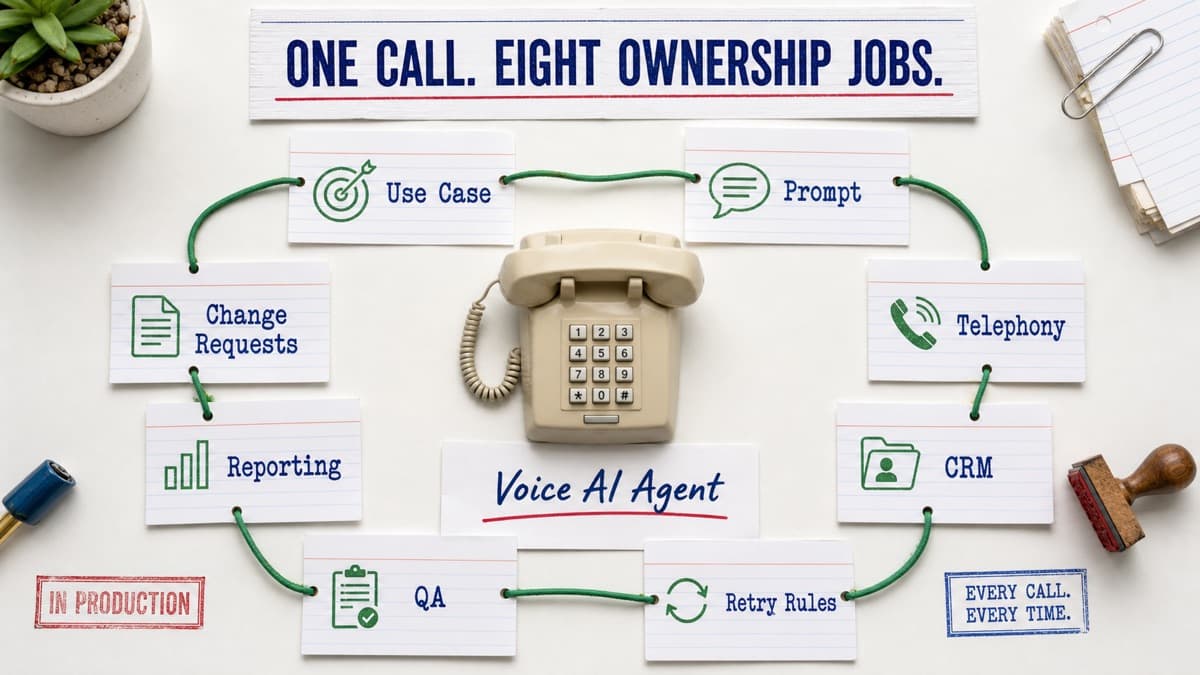
Then comes the work nobody sees in the demo: reviewing failures, changing prompts, testing model or voice updates, investigating carrier issues, correcting CRM mappings and answering new reporting requests. NIST’s AI Risk Management Framework treats deployment, operation, monitoring, evaluation and change management as lifecycle responsibilities involving different actors. A production agent cannot responsibly be treated as a one-time configuration.
The company-stage decision
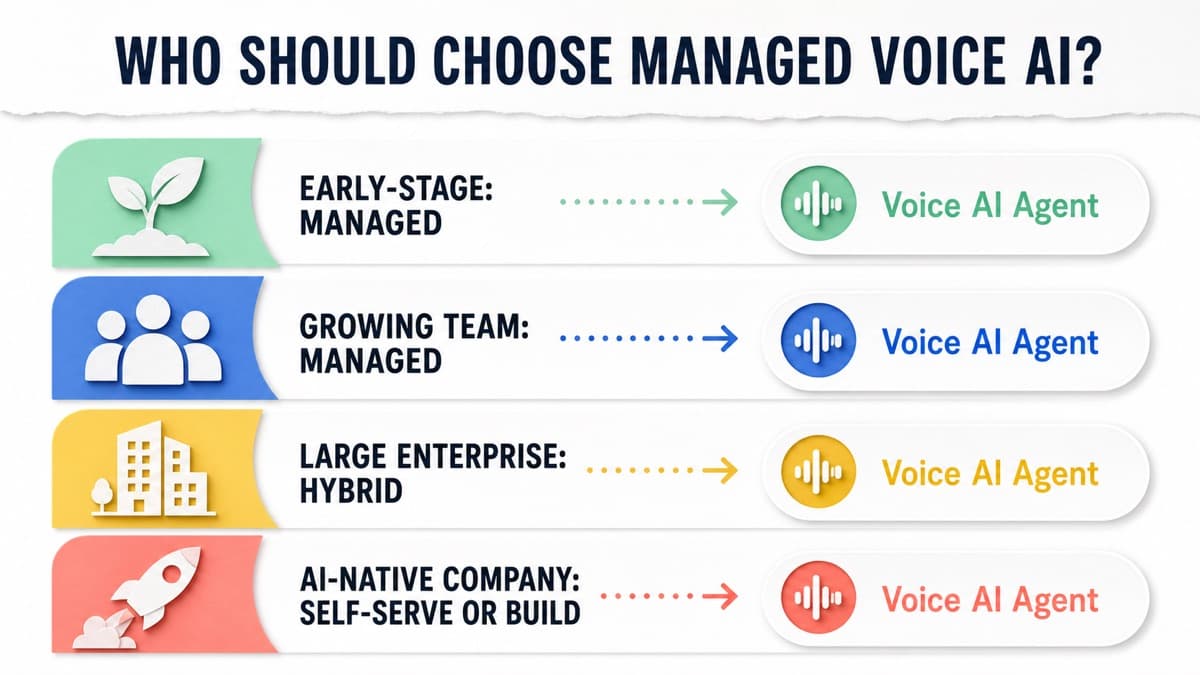
Company size alone is not decisive. A 50-person technology company may have stronger AI operations than a 5,000-person traditional business. The real question is whether the organisation already has people who can own realtime systems, telephony, prompt behaviour, tool integration, QA and business change after launch.
When managed Voice AI is clearly the better choice
Choose managed when speed matters because a missed season, campaign or customer window is expensive. Education admissions, renewals, collections and diagnostic operations often cannot wait six months for an internal team to learn telephony and Voice AI production behaviour.
Choose managed when the use case crosses systems. If calls must read CRM, book slots, trigger WhatsApp, transfer to humans and create custom reports, the difficult work is orchestration and ownership.
Choose managed when the workflow changes weekly. Prices, programmes, territories, scripts, counsellor rosters and reporting definitions move. A vendor that maintains the agent can turn business changes into tested production changes without opening a new internal project each time.
Choose managed when failure needs an owner. If the call connects but the agent fails, the carrier, STT, model, TTS, tool, CRM or prompt may be responsible. Managed service reduces the number of teams the buyer must coordinate during diagnosis.
When managed service is unnecessary
Do not buy managed merely because the company wants a demo quickly. A simple proof of concept can be built on a self-serve Voice AI platform such as Bolna, Vapi or Retell when an engineering team wants to experiment and understands that it will own production.
Do not outsource a capability that is central to the product strategy. A company building a Voice AI product, a contact-centre platform or proprietary conversational infrastructure may need model control, custom orchestration and internal intellectual property.
Managed may also be unnecessary for a stable, low-risk, low-volume workflow where an internal automation team already owns telephony, CRM, monitoring and support. Paying indefinitely for ownership the company already possesses would be wasteful.
Use-case risk changes the answer
The question is therefore use-case dependent, but not in the simplistic sense that one industry should always buy managed. Risk, change frequency, integration depth, customer value and the cost of a wrong action determine how much specialist ownership is useful.
Does speed really matter?
Speed matters when it produces learning before the commercial window closes. It does not matter if the vendor launches an impressive script quickly and leaves integrations, QA and reporting unfinished.
A managed partner should compress four timelines: discovery, production integration, real-call learning and change implementation. The advantage is not merely going live faster. It is reaching a reliable workflow with fewer internal coordination cycles.
Deloitte’s enterprise research describes technical talent, governance and risk management as major barriers to generative AI deployment. Managed service can supply specialist capacity while the organisation develops its own governance and business readiness. It cannot replace executive ownership or repair an undefined business process without cooperation.
Advantages of managed Voice AI
The first advantage is resource leverage. The buyer gains access to prompt, telephony, integration and QA capability without hiring a complete team before proving value.
The second is accountability. One partner owns the behaviour across multiple components instead of every failure becoming a debate between platform, carrier, CRM and model providers.
The third is iteration speed. Production calls become inputs to prompt changes, retry tuning, disposition design and reporting.
The fourth is predictable operating ownership. Marketing, sales and operations know where to send a change request and who is expected to test it.
The fifth is better focus. Internal teams own customer strategy and business decisions while specialists operate the Voice AI layer.
Disadvantages buyers should not ignore
Managed service costs more than the visible platform fee because it includes people and accountability. The correct comparison is total operating cost, including internal engineering and operations, not API price alone.
Vendor dependence can become painful if prompts, call data, phone numbers or integrations are difficult to export. Contracts should define data access, number ownership, documentation and exit support.
The buyer may have less component-level control. A managed provider may choose STT, LLM or TTS routing. This is helpful for buyers seeking outcomes, but unsuitable for teams that need direct model experimentation.
Finally, managed is only as good as the provider. A vendor that takes weeks to change one field or cannot explain failures creates a new bottleneck. Managed should be evaluated on response time, transparency, QA evidence and change ownership, not promises of white-glove service.
What are the alternatives?
How Bolna, ConvoZen and Xtreme Gen AI fit
Bolna represents a platform-led Voice AI path: teams can configure agents and use developer capabilities while retaining more internal ownership. ConvoZen represents a broader conversational AI and customer-engagement route that may appeal to contact-centre and analytics teams. These can be rational choices when the buyer has the resources to operate what it configures.
Xtreme Gen AI is a managed Voice AI Agent company. It builds and maintains prompts and tool logic, supports bulk and API-triggered calls, configures retries and requested callbacks, integrates CRM and webhooks, carries memory between Voice AI and WhatsApp, supports telephony and numbers, creates custom dispositions and reporting, and runs ongoing QA.
The relevant comparison is not which company has the longest feature list. It is which operating model matches the buyer’s resources, risk, speed and desired ownership.
The managed-services scorecard
Ask who writes and maintains the prompt, who tests tool calls, who owns telephony incidents, how often calls are reviewed, how quickly changes reach production and which metrics prove improvement.
Ask for a responsibility matrix covering the buyer and vendor. The business should always own policy, approved knowledge, customer promises and final accountability. The vendor may own implementation, operation and improvement, but it should never invent business rules because nobody internally made a decision.
Ask how you leave. Export rights, recordings, transcripts, prompts, dispositions, reports, integration documentation and phone-number portability should be discussed before launch. A good managed partner should make the service valuable enough to retain, not technically difficult to exit.
Research references
McKinsey: The state of AI, organisational rewiring and workflow redesign
NIST Artificial Intelligence Risk Management Framework
NIST report on monitoring deployed AI systems
Deloitte State of Generative AI in the Enterprise
Try the Voice AI Agent
To experience the Voice AI Agent directly, call from your mobile. Time the call if you like, but also test whether it understands the request, creates the right next action and leaves useful context. A cheap minute that produces no dependable outcome is not cheap.
Conclusion
Managed Voice AI is the best default for most companies because most companies want a reliable calling outcome, not a new infrastructure and operations department. It converts specialist work into accountable service while the business keeps ownership of customers, policy and results.
It is not universally best. AI-native organisations, mature enterprises and stable low-risk workflows may justify self-serve, internal or hybrid models. The decision should follow company stage, internal capability, use-case risk, speed, change frequency and strategic importance.
The honest question is not whether your team can build a demo. It is whether your team wants to own every production job after the demo succeeds.