Highlights
- Highlights
- Why corporate health-check campaigns become difficult at scale
- What a Voice AI Agent should handle
- The agent must distinguish logistics from clinical conversation
- How the CRM, LIS, scheduling system and WhatsApp should connect
- Regional-language support should follow employee preference
- What CMOs, founders and operations leaders should measure
- What CTOs should test before production
- Where Xtreme Gen AI fits
- Conclusion

Voice AI for Corporate Health Check Calls: From Employee Outreach to Confirmed Slots
By Peush Bery
Published: June 24, 2026
A corporate health-check programme may look straightforward on a spreadsheet: receive an employee list, call each person, offer a slot, share preparation instructions, complete the test, and send the report. In practice, diagnostic labs face unanswered calls, shift workers, changing office schedules, duplicate records, fasting questions, preferred locations, home-collection requests, and employees who agree but never confirm a slot.
The scale of the health problem makes organised screening important. The 2023 ICMR-INDIAB national study estimated diabetes prevalence at 11.4%, prediabetes at 15.3%, and hypertension at 35.5% among adults in India. These numbers do not mean every employee requires the same package or that an automated call can provide medical advice. They show why employers and diagnostic providers need dependable operating systems for outreach, booking, instructions, and follow-through.
Voice AI for corporate health check calls can create that operating layer. A Voice AI Agent can contact employees in approved calling windows, explain the purpose of the programme, capture consent to continue, offer eligible slots, record location and language preferences, send approved instructions, manage simple rescheduling, and update the campaign system. The agent should not interpret symptoms, recommend tests, or explain abnormal results. Those conversations belong with qualified people.
Highlights
What diagnostic and corporate health leaders should take away
- Corporate health-check campaigns are operational workflows, not one-time blast calling.
- Employee outreach should connect directly to available capacity, location, package eligibility, preparation instructions, and the diagnostic lab's system of record.
- ICMR-INDIAB reported estimated adult prevalence of 11.4% for diabetes, 15.3% for prediabetes, and 35.5% for hypertension in India.
- A Voice AI Agent can handle approved outreach, consent capture, booking, reminders, simple rescheduling, and structured dispositions.
- Clinical advice, package exceptions, sensitive objections, symptoms, and report interpretation require human escalation.
- The useful output is a confirmed slot and a clean CRM or LIS update, not merely a transcript.
- Diagnostic leaders should measure completed bookings, attendance, campaign reach, capacity utilisation, data quality, and human escalation quality.
Why corporate health-check campaigns become difficult at scale
The challenge is not usually a shortage of employee names. It is coordination. One employer may have offices in several cities, different shifts, contract workers, remote employees, and varying packages by grade or age band. The diagnostic partner may be operating fixed on-site camps, branch appointments, and home sample collection at the same time. A central team must keep these rules aligned while the campaign is already running.
Manual calling often separates the conversation from capacity. A caller may promise a morning slot without checking the camp limit, record a callback in personal notes, or send a generic message that does not match the selected package. The employee then arrives without the correct preparation, calls again to clarify, or drops out. The failure is not only in the call; it is in the gap between calling, scheduling, instructions, and the diagnostic workflow.
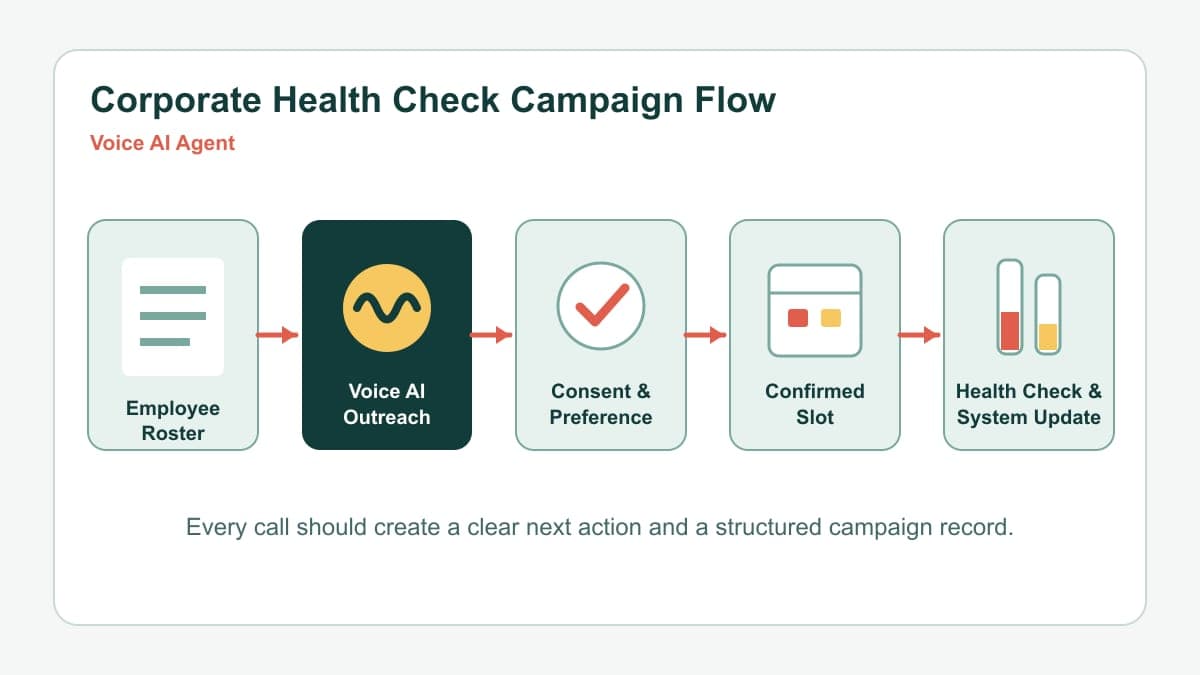
WHO's healthy-workplace framework recommends systematic and comprehensive workplace programmes rather than isolated activities. For diagnostic providers, that principle translates into a practical requirement: the campaign must be designed as an end-to-end service. Outreach cannot be treated as complete until the employee has a clear next action and the operation has a reliable record.
What a Voice AI Agent should handle
The first job is identity and campaign context. The agent should confirm that it is speaking to the intended employee without exposing unnecessary personal information. It should identify the employer programme, use the approved explanation, ask whether the employee wants to continue, and follow the organisation's consent and privacy rules. If the employee declines or asks not to be contacted again, that instruction must be recorded immediately.
The second job is appointment orchestration. The Voice AI Agent can ask for city or office location, preferred date, available time window, and whether the employee needs a branch visit, corporate camp, or an approved home-collection option. It should offer only slots returned by the scheduling system. When a slot is confirmed, the agent can trigger the approved WhatsApp or SMS message with location, preparation instructions, and a rescheduling path.
The third job is structured follow-up. The system can remind employees who booked, retry people who requested a callback, reopen released slots, and classify outcomes such as confirmed, reschedule requested, unreachable, declined, duplicate record, ineligible, needs human support, or already completed. These dispositions are more useful than a long call recording because campaign managers can act on them.
The agent must distinguish logistics from clinical conversation
Corporate health-check calls can move from logistics to medical questions quickly. An employee may ask whether a test is safe during pregnancy, whether medicine should be stopped before fasting, whether a symptom changes the recommended package, or what an earlier result means. A Voice AI system should not improvise an answer because the question sounds familiar. It should acknowledge the question and transfer or schedule a callback with an authorised clinical or diagnostic representative.
The same applies to package exceptions and employer-policy disputes. If an employee wants an additional test, challenges eligibility, asks about reimbursement, or requests a location outside the contracted network, the agent should capture the request and route it. A good automation programme is defined partly by what it refuses to automate.
For CTOs and CPOs, this boundary should exist in configuration, not only inside a prompt. The system needs approved knowledge, prohibited-topic rules, escalation categories, transfer destinations, fallback behaviour when a transfer fails, and an audit trail showing why the handoff happened.
How the CRM, LIS, scheduling system and WhatsApp should connect
Voice AI for diagnostic labs becomes useful when the call changes the next system action. Before dialling, the agent may need employer ID, employee reference, eligible package, campaign window, allowed locations, available capacity, language preference, and previous attempt history. After the call, it should return a booking ID, slot, channel consent, call disposition, callback time, escalation reason, and communication status.
The scheduling system should remain the source of truth for capacity. The laboratory information system or campaign platform should remain the source of truth for fulfilment and completion. The Voice AI Agent should orchestrate these systems rather than create a parallel database that managers must reconcile manually.
WhatsApp follow-up should also be outcome-based. A confirmed employee receives the correct slot and preparation message. A person who requested a callback receives an acknowledgement and time. A person who declined should not receive a booking reminder. A person escalated for a clinical question should receive only an appropriate confirmation that a qualified team member will follow up.
Regional-language support should follow employee preference
Corporate workforces in India are multilingual, and campaigns can span head offices, plants, warehouses, sales teams, and remote staff. Restricting the workflow to Hindi and English can reduce clarity even when those are the largest call volumes. The better design is to capture language preference from employer data or at the beginning of the call and support the regional languages required by the workforce.
Language support is more than translating a script. Test names, location names, dates, fasting instructions, and alphanumeric employee references must be pronounced and confirmed correctly. The system also needs to handle code-switching, interruptions, background noise, and employees who change language during the call. Each supported language should be tested against real campaign vocabulary before launch.
What CMOs, founders and operations leaders should measure
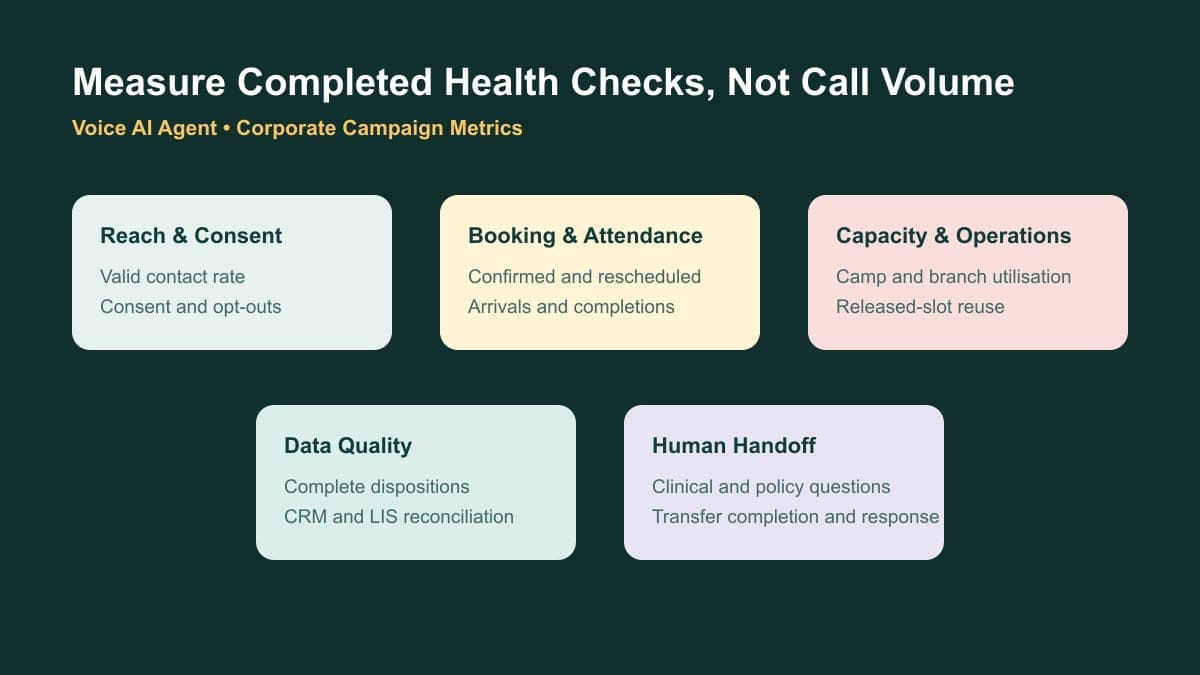
Call volume is not the primary success metric. Campaign leaders should measure unique employees reached, valid contact rate, consent to continue, eligible employees, confirmed bookings, rescheduling rate, attendance, completed health checks, released-slot reuse, and the percentage of records with complete dispositions. These measures show whether outreach is creating fulfilment rather than activity.
Capacity utilisation matters as well. If a corporate camp can process 150 people but only 90 arrive, the outreach and reminder system has left operational value unused. If the campaign overbooks without accounting for test duration or location constraints, employee experience suffers. Voice AI should be connected to capacity rules so it can help fill slots without creating a new queue.
Founders and CEOs should also examine human-time allocation. The system should reduce repetitive confirmation calls while ensuring that employees with clinical questions, sensitive concerns, complaints, or exceptions reach the right person faster. The business case is stronger when automation improves both campaign throughput and the quality of human conversations.
What CTOs should test before production
A successful demo call proves very little about a live corporate campaign. CTOs should test how the system behaves with stale employee lists, duplicate phone numbers, unavailable slots, incorrect language tags, failed WhatsApp delivery, employee opt-outs, transfer failures, and partial outages in the scheduling or LIS integration. Idempotency is important: a retry should not create two bookings.
Security and data minimisation should be explicit. The Voice AI Agent should receive only the fields required for the conversation, access should be role-controlled, recordings and transcripts should follow the agreed retention policy, and sensitive data should not be repeated unnecessarily on a call. Employer and diagnostic-provider responsibilities should be documented before the campaign starts.
Monitoring should cover business and technical performance together. Teams need dashboards for call outcomes, booking errors, transfer failures, latency, abandoned calls, opt-outs, language-level quality, and reconciliation gaps between the campaign platform and diagnostic systems. Production Voice AI is an operated service, not a script that is deployed once.
Where Xtreme Gen AI fits
Xtreme Gen AI builds Voice AI Agents for production diagnostic workflows. For corporate health-check campaigns, the system can handle approved employee outreach, language preference, consent capture, slot booking, reminders, simple rescheduling, WhatsApp follow-up, structured dispositions, CRM or campaign-platform updates, and human escalation.
The implementation work includes telephony, scheduling and CRM integration, campaign rules, regional-language testing, transfer logic, monitoring, and workflow tuning. The objective is not to automate medical judgement. It is to make the operational path from employee list to completed health check more dependable. To experience the Voice AI Agent, call 9228034172
Conclusion
Corporate health-check campaigns combine workplace communication, diagnostic capacity, personal preferences, preparation requirements, and sensitive questions. When these are managed through disconnected spreadsheets, manual calls, and generic messages, the campaign loses employees between outreach and completion.
A Voice AI Agent can make the repeatable part of the workflow consistent: contact, consent, booking, instructions, reminders, rescheduling, and system updates. Human teams should remain responsible for clinical questions, exceptions, trust, and judgement. For diagnostic providers, that combination can turn corporate health-check outreach into a measurable operating process rather than a calling exercise.
Frequently Asked Questions
1. What systems should a Voice AI Agent integrate with for a corporate health-check campaign?
It should normally integrate with the employee or campaign roster, appointment scheduler, diagnostic CRM or campaign platform, LIS where appropriate, telephony, and the approved WhatsApp or SMS provider. The scheduler should remain the source of truth for slot capacity, while the campaign or laboratory system should record completion and fulfilment.
2. How should a diagnostic lab measure ROI from Voice AI for employee health-screening calls?
Measure unique employees reached, confirmed bookings, attendance, completed health checks, released-slot reuse, cost per completed booking, capacity utilisation, CRM completeness, and repetitive human calling hours reduced. Call volume alone does not show whether the campaign produced completed tests.
3. Can Voice AI answer employee questions about fasting, medicines, pregnancy, symptoms, or test results?
It may share narrowly approved preparation instructions, but questions involving medicines, pregnancy, symptoms, package suitability, abnormal results, or clinical interpretation should be escalated to an authorised human. The escalation rule should be configured and audited rather than left to model judgement.
4. How can a CTO prevent duplicate bookings and incorrect slots during automated corporate diagnostic campaigns?
Use real-time availability from the scheduling system, idempotent booking APIs, unique campaign and employee references, confirmation before final booking, and reconciliation between the Voice AI workflow and the source systems. Test retries, outages, stale lists, shared phone numbers, and rescheduling before production.
5. Should corporate health-check Voice AI support only Hindi and English?
No. Language coverage should follow the actual workforce and campaign geography. Hindi and English may be important, but diagnostic providers should support the regional languages required by office, plant, warehouse, field, and remote employees, with real testing for test names, locations, dates, and code-switching.