Highlights
- By Peush Bery, Xtreme Gen AI
- Highlights
- Why applications stall after interest is created
- Application follow-up needs stage-aware calling
- What the Voice AI Agent should capture
- Where WhatsApp should support the call
- Consent, data, and calling discipline
- Why official programme information matters
- The metrics founders and CMOs should track
- Where counsellors still matter
- Where Xtreme Gen AI fits
- Conclusion

Voice AI for Course Application Follow-Ups: Turning Serious Learners Into Completed Files
By Peush Bery
Published: June 27, 2026
By Peush Bery, Xtreme Gen AI
Most course-selling organisations do not lose serious learners only at the top of the funnel. They lose them after the learner has already spoken to someone, shown intent, asked for programme details, or started an application. The gap is usually boring but expensive: missing documents, unclear eligibility, incomplete forms, delayed payment links, forgotten callbacks, and counsellor queues with no clean next action.
This is where course application follow up calls become important. A learner who has moved beyond casual enquiry needs a different workflow from a cold lead. The conversation should not simply ask, “Are you interested?” It should help the learner complete the next step: submit the application, confirm eligibility, share documents, choose a batch, schedule a counsellor call, or receive a WhatsApp reminder with the right link.
Voice AI for course admissions can make this stage more disciplined. The Voice AI Agent can call at the right time, remember the previous conversation, ask for the missing item, update the CRM, trigger WhatsApp follow-ups, schedule callbacks, and route complex cases to counsellors. The result is not just more calls. The result is more completed files for the admissions team to work on.
Highlights
What education leaders should take away
- Application follow-up is different from first lead qualification because the learner has already shown some level of intent.
- The Voice AI Agent should know the learner stage, missing application items, programme interest, callback history, and counsellor owner before calling.
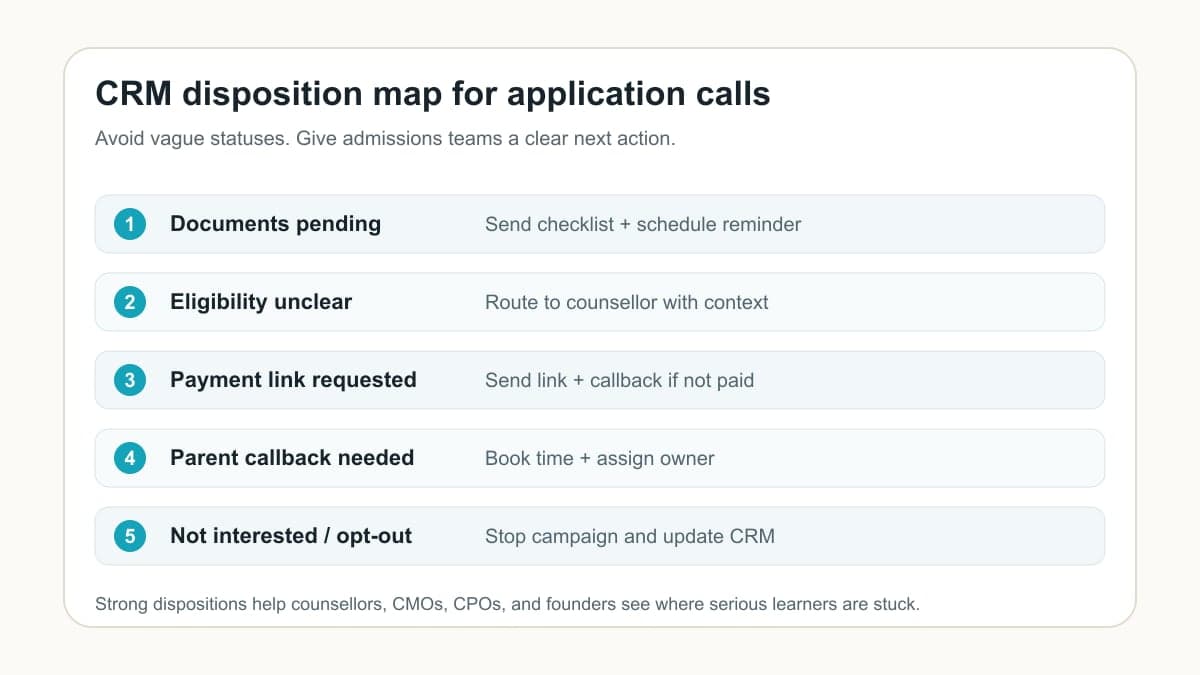
- Good follow-up workflows reduce CRM ambiguity: pending document, eligibility unclear, payment link requested, parent callback needed, counsellor handoff required.
- Education teams should measure completed applications, document completion rate, callback completion, counsellor-ready leads, and stalled-file recovery.
- DPDP and TRAI make consent, opt-out, retention, and responsible calling important for learner data.
- UGC and official higher-education context make accurate programme information important, especially for online, distance, certification, and degree-linked offerings.
- The strongest model combines Voice AI calls, WhatsApp reminders, CRM dispositions, smart memory, and human counsellor escalation.
- The goal is not to replace counsellors; it is to protect their time for learners who are ready for a serious decision.
Why applications stall after interest is created
Admissions teams often focus heavily on lead generation and first response. That makes sense because fresh leads decay quickly. But after the first call, a different problem appears. The learner may need to upload an ID proof, share education details, confirm work experience, choose a specialisation, discuss batch timing, speak with a parent, or clarify whether the programme is online, hybrid, or classroom-based.
These tasks rarely look dramatic in a dashboard. They show up as “callback”, “interested”, “documents pending”, or “follow-up later”. Over time, those vague statuses create a silent admissions leak. Counsellors spend time reopening old notes, managers cannot see which files are actually close to completion, and learners receive inconsistent reminders.
A good Voice AI Agent does not treat this as a generic sales call. It treats it as an admissions operations call. The agent should know what is missing, what was promised earlier, what the learner asked for, and what action should be completed after the call. Without that context, automation only creates another layer of noise.
Application follow-up needs stage-aware calling
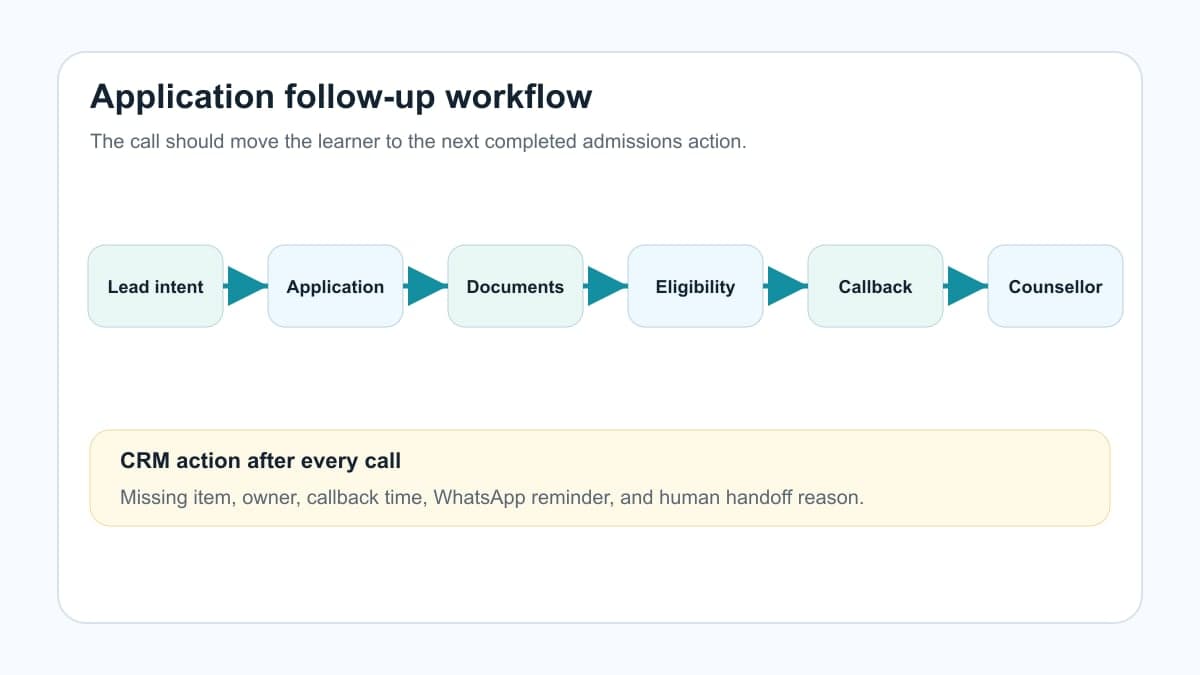
A fresh enquiry needs qualification. An application-stage learner needs stage-aware guidance. The script, tone, and CRM action should change depending on whether the learner has filled the form, paid the registration fee, uploaded documents, selected a batch, or asked for a counsellor callback.
For example, a learner who has completed the form but not uploaded documents should receive a different call from someone who has only asked about fees. A learner waiting for eligibility confirmation should not be pushed with the same payment reminder as someone who has already been approved. These details decide whether the call feels useful or irritating.
This is why admissions CRM automation matters. The CRM should hold the current stage, missing item, owner, last conversation, next action, and preferred callback time. The Voice AI Agent should read these fields before calling and write back a clean disposition after the call.
What the Voice AI Agent should capture
The call output should be structured. At minimum, the system should capture application stage, missing document, programme name, eligibility concern, batch preference, payment-link request, parent or decision-maker callback, WhatsApp reminder need, and counsellor handoff reason. It should also record whether the learner asked not to be called again or requested a specific callback slot.
This information should not sit only inside a transcript. Transcripts are useful for QA, but admissions teams need fields they can filter. A CMO should be able to see how many application-stage learners are blocked because of documents. A CPO should be able to see where the workflow breaks. A founder should be able to see how many serious files were recovered without increasing counsellor headcount.
Custom dispositions are important here. “Interested” is too broad. Better dispositions are “application started”, “documents pending”, “eligibility clarification needed”, “payment link requested”, “parent callback needed”, “batch timing issue”, “counsellor transfer required”, and “not eligible”. These labels help the next team act without decoding a long call summary.
Where WhatsApp should support the call
Education buyers in India often expect a WhatsApp follow-up after a call. The learner may not remember a document list, payment link, eligibility checklist, or counselling slot while speaking. A Voice AI Agent can complete the call and then trigger a WhatsApp reminder with the right next step.
The important part is shared memory. If the learner replies on WhatsApp and later receives another call, the next conversation should know what happened. If the learner asks for a callback after sharing documents, the AI should not behave as if it is starting from zero. This continuity is where voice plus WhatsApp becomes stronger than either channel alone.
For admissions teams, this also creates cleaner reporting. Instead of running calls and WhatsApp messages as disconnected campaigns, the CRM can show a single learner journey: called, link sent, document pending, reminder sent, callback scheduled, counsellor assigned.
Consent, data, and calling discipline
Course application follow-up involves personal information: phone number, name, education history, work experience, city, programme interest, and sometimes payment or identity-document status. The Digital Personal Data Protection Act, 2023, makes notice, consent, purpose limitation, retention, and withdrawal important when processing personal data.
Outbound calling also needs discipline. TRAI’s commercial communication framework is a reminder that businesses should respect consent, preferences, and accountable communication practices. For education teams, this means the Voice AI Agent should capture opt-outs, avoid excessive retries, and follow campaign rules.
This is not only a compliance point. It is also good customer experience. A learner who asked for a callback tomorrow should not receive repeated calls today. A learner who says they are no longer interested should not stay in the same calling queue. Good automation should reduce irritation, not scale it.
Why official programme information matters
Course-selling organisations must be careful about what is said during admissions calls. UGC and official education portals exist because learners need accurate information about institutions, online or distance programmes, recognition, and higher-education pathways. A Voice AI Agent should not improvise claims about degree recognition, eligibility, placements, refunds, or certification value.
The safer model is controlled knowledge. The agent should use approved programme information, approved fee and document checklists, approved eligibility rules, and approved handoff points. If the learner asks a question outside the approved scope, the call should be transferred or scheduled for a counsellor.
This protects both the learner and the organisation. It also protects the brand. One wrong commitment by a human or AI agent can create refund disputes, complaints, or trust issues.
The metrics founders and CMOs should track
The right metric is not simply number of follow-up calls completed. The stronger metrics are application completion rate, document completion rate, callback completion rate, counsellor-ready leads, payment-link requests, stalled-file recovery, and time from application start to completed file.
CMOs should also compare campaign source quality at this stage. Some channels may generate many leads but few completed files. Others may generate fewer leads but better application completion. Voice AI can help reveal this because every call can write structured outcome data back to CRM.
For founders, the useful commercial question is whether the admissions team can move more serious learners forward without hiring more callers. If AI only increases call count, it is not enough. If it increases completed files, counsellor productivity, and clean CRM visibility, it is helping the business.
Where counsellors still matter
Course application follow-up should not remove counsellors from important conversations. Counsellors are still needed for persuasion, complex eligibility cases, parent discussions, career concerns, placement questions, refund doubts, and learners who are comparing multiple institutes.
The better model is Voice AI before the counsellor. The AI handles repeatable follow-up, confirms missing items, sends reminders, schedules callbacks, and updates CRM. Counsellors then receive cleaner context and spend time on learners who actually need human judgement.
This also improves the learner experience. Instead of repeating the same background on every call, the learner moves through a more organised journey. The AI remembers the last call, WhatsApp carries the next step, and the counsellor sees the context before speaking.
Where Xtreme Gen AI fits
Xtreme Gen AI builds managed Voice AI Agent workflows for production admissions teams. For course application follow-ups, this means more than a script. It means custom retry rules, CRM-triggered calling, bulk upload campaigns, WhatsApp follow-ups, custom dispositions, call summaries, recordings, transcripts, smart memory, and human handoff.
The agent can be customised around each organisation’s programme list, eligibility criteria, document checklist, counsellor routing rules, callback policy, and reporting needs. Xtreme Gen AI also maintains the agent flow, prompt, tool calling, QA, and improvements after launch, so the business is not left alone with a self-serve voicebot that someone internally has to manage every week.
If you want to experience how a Voice AI Agent handles a real conversation, call 9228034172. Listen for how the agent captures intent, remembers context, and moves the next action forward.
Conclusion
Course application follow-up is one of the most practical places to use Voice AI for course admissions. The learner has already shown intent, the next steps are usually structured, and the business outcome is measurable. The challenge is not only making more calls; it is turning those calls into completed files.
For education founders, CMOs, CPOs, and CTOs, the question is simple: how many serious learners are stuck because the next action is unclear, delayed, or not owned? A well-designed Voice AI Agent can make that stage disciplined, measurable, and easier for counsellors to close.
Frequently Asked Questions
1. How can Voice AI improve course application follow-up after a learner has shown interest?
Voice AI can call learners at the application stage, identify what is missing, capture document or eligibility issues, schedule callbacks, trigger WhatsApp reminders, and update the CRM with a clear next action. This helps admissions teams move serious learners from interest to completed application files.
2. What CRM fields should an education Voice AI Agent update during application follow-up calls?
Useful fields include application stage, missing document, programme interest, eligibility concern, preferred batch, payment-link request, callback time, parent or decision-maker involvement, WhatsApp reminder status, counsellor owner, and handoff reason. These fields are more useful than vague labels like interested or callback.
3. Should course application follow-up be handled by AI or human counsellors?
The strongest model is AI before the counsellor. Voice AI can handle repeatable reminders, document follow-ups, callback scheduling, and CRM updates. Human counsellors should handle persuasion, complex eligibility, parent discussions, career concerns, and final decision conversations.
4. How should education teams measure ROI from Voice AI application follow-ups?
Measure completed applications, document completion rate, callback completion, counsellor-ready leads, stalled-file recovery, payment-link requests, and time from application start to completed file. These metrics show whether Voice AI is improving admissions outcomes, not only increasing call volume.
5. What compliance checks matter for AI calling in course admissions?
Education teams should check consent, opt-out handling, retry limits, data retention, approved programme information, CRM access controls, call recordings, and who can see transcripts. The Voice AI Agent should use approved knowledge and escalate questions about recognition, refunds, eligibility, or commitments to human counsellors.