Highlights
- By Peush Bery — CEO, Xtreme Gen AI
- Why diagnostics is now a speed-and-follow-up business in India
- The old reality: where revenue leaks before the test even happens
- Why missed calls hurt diagnostic labs more than most businesses
- What changes with a Voice AI + WhatsApp + Website Chat front desk
- What an India-ready diagnostic AI agent does well
- Case-study patterns we see in 50+ location lab networks
- Revenue leakage model: what happens when test-intent doesn’t convert
- Why AI can outperform humans for L1 diagnostic communication
- What production looks like: hybrid, integrated, and governed
- How to start for a 50+ centre diagnostic brand
- Conclusion

Voice AI Agents for Indian Diagnostic Labs: From Missed Calls to Measurable Bookings
By Xtreme Gen Ai
Published: February 7, 2026
|Last Updated: February 8, 2026
By Peush Bery — CEO, Xtreme Gen AI
Why diagnostics is now a speed-and-follow-up business in India
India’s diagnostic labs are no longer “walk-in first.” Patients compare prices, ask prep questions, expect home collection, and want confirmations on WhatsApp—fast. For multi-location diagnostic brands (50+ centres), demand is rarely the problem. Response time, consistent information, and operational follow-up are the bottlenecks that decide whether a test-intent patient books with you or moves on to the next option.
This is why call-centre managers and product leaders in diagnostics track the same signals e-commerce teams do: speed-to-answer, abandonment, and conversion. If your phone rings unanswered at 8 AM during fasting-hour rush, or your WhatsApp queue piles up over the weekend, you don’t just lose a conversation—you lose a booking, and often the customer for the next preventive package too.
The old reality: where revenue leaks before the test even happens
Across most diagnostic networks, patient intent shows up as a phone call or message: “CBC ka price?”, “thyroid fasting hota hai?”, “home collection milega?”, “nearest centre timing?”, “report kab milegi?”, “insurance/corporate valid?” These are high-volume, repetitive questions—yet they directly influence conversion.
The challenge is not just volume. Diagnostics adds complexity: morning spikes for fasting tests, weekend surges for preventive packages, multi-language conversations, and operational coordination for home collection. Add prep confusion and report anxiety—patients call repeatedly for status and timelines—and your support load becomes unpredictable, while staffing remains fixed.
Why missed calls hurt diagnostic labs more than most businesses
In diagnostics, a missed call is rarely “a missed query.” It’s often a time-sensitive intent: a patient wants to book a fasting slot tomorrow morning, confirm whether a test needs fasting, or schedule a home collection before office hours. If they don’t get a quick answer, they choose a competitor that responds faster. That’s why answering speed is not a vanity metric in diagnostics—it’s direct revenue protection.
This becomes brutal at scale. In a 50+ centre network, even a small abandonment percentage—during peak hours—can translate into dozens of lost bookings every day. And unlike many categories, diagnostics is repeatable. The patient who books a preventive package today is also the patient who returns for follow-ups, family testing, and corporate camps. Miss the first booking, and you risk losing the lifetime relationship.
What changes with a Voice AI + WhatsApp + Website Chat front desk
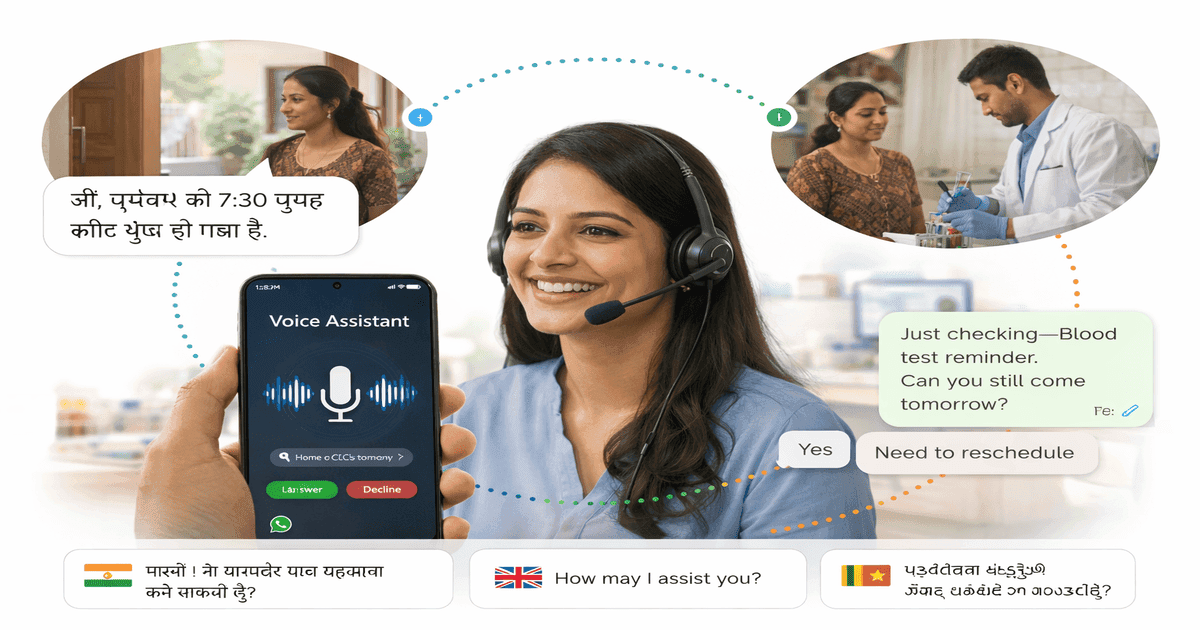
A modern AI agent stack covers voice calls, website chat, and WhatsApp—so patients can start anywhere and still get consistent answers. Voice AI handles inbound calls instantly, while chat automation absorbs the constant stream of “timing, price, prep, report ETA” questions. The result is a unified front desk that runs 24×7 and doesn’t collapse under spikes.
The real unlock is that the AI is not just “talking.” It collects structured data: patient name, pincode/area, preferred slot, test list, fasting requirement, home collection vs centre visit, and any constraints. That structured payload can be pushed into your CRM/LIS/LIMS workflow via API/webhook—so operations gets booking-ready details instead of messy, unstructured chats.
What an India-ready diagnostic AI agent does well
First, it answers instantly, 24×7. No queue music, no hold, no “call back later.” It resolves repetitive L1 questions—pricing ranges, timings, prep rules, report delivery options—and routes only complex cases to humans. Second, it books appointments for centre visits or home collections by collecting the minimum required details and confirming the slot in the same interaction.
Third, it runs follow-ups that humans forget. Automated confirmations and reminders reduce no-shows, and rescheduling flows recover capacity when patients can’t come. Fourth, it’s multilingual by default—Hindi + English plus regional languages—while keeping prep instructions standardized and approved. In diagnostics, language isn’t a “feature.” It’s conversion.
Case-study patterns we see in 50+ location lab networks
Case Pattern 1: Morning rush overflow. Before, call queues and missed calls peak during fasting hours, and patients drop off to competitors. After, Voice AI answers immediately, resolves common questions, and books appointments, while transferring only exceptions. The human team shifts focus to escalations, complex packages, and corporate accounts—without drowning in repetitive calls.
Case Pattern 2: Home collection scheduling chaos. Before, WhatsApp intake is incomplete (“Kal subah aana”), addresses are wrong, fasting isn’t clarified, and phlebotomists face failed pickups and reschedules. After, the AI collects address/pincode, landmark, preferred time window, fasting requirement, and test list, then pushes a structured job to dispatch. The pattern that follows is fewer failed pickups, fewer reschedules, and better phlebotomist utilization.
Case Pattern 3: Report-status anxiety. Before, centres get flooded with “report aaya kya?” calls that don’t create new revenue but consume staff time. After, the AI shares report status and ETA (when integrated with LIS/LIMS), and escalates only outliers. This reduces inbound load while improving patient trust and transparency.
Revenue leakage model: what happens when test-intent doesn’t convert
Here’s a simple way to estimate preventable leakage. If your network receives 1,000 test-intent enquiries per day across calls and chat, and 8% drop off due to missed calls or slow replies, that’s 80 lost intents daily. If even half of those would have converted with fast handling, you’re losing 40 bookings per day. At an average order value of ₹1,200, that’s ₹48,000 per day—around ₹14.4 lakh per month of leakage. Replace these numbers with your actual volumes and AOV to get your baseline.
The point is not the exact assumption—it’s the direction. Diagnostics conversion is highly sensitive to response speed and clarity. When patients are comparing labs in real time, the first brand that answers confidently and confirms a slot usually wins.
Why AI can outperform humans for L1 diagnostic communication
Humans are better at empathy and judgement. But for L1 diagnostic coordination, AI can outperform on consistency and speed. It answers instantly, never forgets follow-ups, and delivers the same prep guidance every time. It also offers full visibility: centre-wise demand, language demand, peak windows, top queries, booking conversion, and transfer rates—so managers can run operations like a measurable funnel instead of a daily firefight.
Most importantly, AI protects your human team. It removes the repetitive load so agents can handle escalations, complaints, corporate contracts, and sensitive conversations. In practice, the best outcomes come from a hybrid setup where AI is the default front desk and humans remain the safety net.
What production looks like: hybrid, integrated, and governed
In a production setup, Voice AI answers inbound calls and transfers complex cases to a live agent. Website chat captures intent and answers FAQs. WhatsApp confirms bookings, shares prep instructions, sends reminders, supports rescheduling, and provides status updates. Integrations connect these channels to your CRM/LIS/LIMS via APIs or webhooks so operations receives clean, structured data.
Governance matters in healthcare. The AI should collect only what’s needed to book and coordinate, use approved knowledge for prep instructions, keep audit logs, and escalate anything that crosses into medical interpretation. Design it as a diagnostics coordinator—not a clinician—and you get impact without introducing avoidable risk.
How to start for a 50+ centre diagnostic brand
Start with a pilot in 1–2 cities or one high-volume business line. Implement the highest-leak workflows first: L1 query handling, booking, and confirmations/reminders. If deep integration is not available on day one, begin with a “collect and summarise” flow that pushes booking-ready details to your team, then move to direct slot booking once stable.
Measure outcomes with a simple scorecard: speed-to-answer, abandonment/missed calls, booking conversion, no-show rate, home collection success rate, transfer rate to humans, and staff hours saved. When the numbers improve in the pilot, expansion becomes a straightforward rollout—language by language, centre by centre, workflow by workflow.
Conclusion
For Indian diagnostic labs, the next phase of competition is not only pricing or location density—it’s responsiveness and operational follow-through. Voice AI agents, paired with WhatsApp and website chat, turn missed calls into answered conversations, enquiries into confirmed bookings, and cancellations into recovered slots. In a 50+ centre network, that shift is the difference between running support as a cost centre and running it as a measurable booking engine.
Frequently Asked Questions
1. How do diagnostic labs reduce missed calls without hiring more agents?
Use Voice AI as the first line for L1—instant pickup, 24×7, and consistent answers to pricing, prep, timings, location, and report ETA. Let it book appointments or capture booking-ready details, and transfer only exceptions (complaints, corporate billing, complex cases) to humans. The impact shows up in speed-to-answer, lower abandonment, and higher booking conversion—without adding peak-hour headcount.
2. Can AI actually book home collections for diagnostic labs end-to-end?
Yes, if it’s connected to your scheduling/dispatch flow. The AI should capture structured fields—patient name, pincode, address/landmark, test list, fasting requirement, preferred slot window, and payment/corporate flags—then create an order/lead in CRM/LIS/LIMS and trigger dispatch. If deep integration isn’t ready, start with “collect + validate + summarize” to ops, then move to direct slot booking.
3. What percent of our calls can AI safely automate for a diagnostic lab without risking patient trust?
In diagnostics, a large chunk is operational: pricing range, centre timings, prep instructions, home collection availability, booking/reschedule, and report ETA. That’s the safest automation zone—because it’s deterministic and policy-driven. Anything involving medical interpretation, report meaning, or complaints should escalate to humans. In practice, you design a strict boundary: “coordination-only,” with transfers for anything subjective or sensitive.
4. We as diagnostic lab get flooded with ‘report ready?’ calls—can AI handle status without breaking privacy?
Yes, if you add lightweight verification and integrate with your status feed. The AI can ask for mobile number plus DOB/order ID (depending on your policy), fetch status from LIS/LIMS, and share only allowed information—like stage and ETA. Anything abnormal—missed TAT, repeated delays, angry tone—routes to humans. Done right, this cuts repetitive inbound load while staying within privacy boundaries.