Highlights
- By Peush Bery, Xtreme Gen AI
- Highlights
- Why diagnostic calls become data problems
- The LIS and CRM do different jobs
- What the Voice AI Agent should capture on every relevant call
- The first workflows to integrate
- Where ABDM changes the expectation
- Consent and calling governance cannot be an afterthought
- NABL thinking: quality is not just inside the lab
- The integration architecture CTOs should ask for
- How to measure whether it is working
- Where humans still matter
- Where Xtreme Gen AI fits
- Conclusion

Voice AI for Diagnostic Labs: Why LIS and CRM Integration Matters More Than the Call Script
By Peush Bery
Published: June 26, 2026
By Peush Bery, Xtreme Gen AI
For diagnostic labs, the real test of a Voice AI Agent is not whether it can speak politely. The real test is whether the call creates the right action inside the lab. A patient may ask for a home sample collection slot, a doctor may call about a report, a corporate HR team may ask about health-check availability, or an existing customer may want to know whether a package includes a specific test. If the call ends with only a transcript, the operations team still has to do the hard work manually.
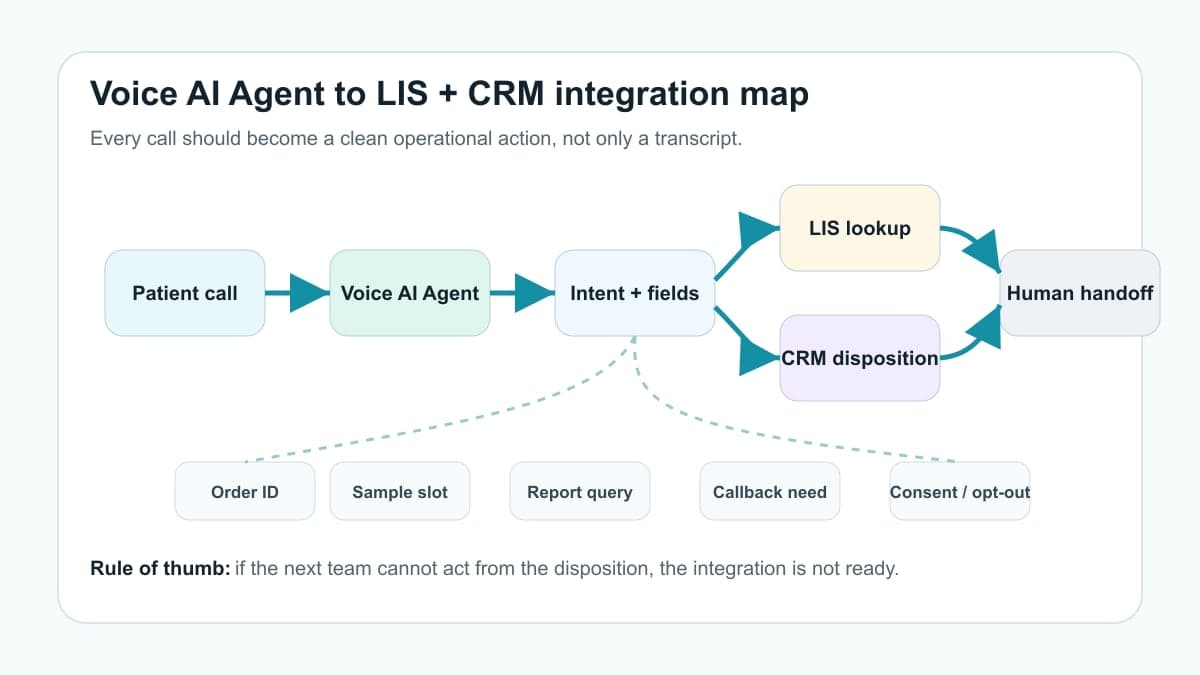
This is why diagnostic LIS integration Voice AI should be evaluated differently from a normal calling tool. The conversation layer matters, but the system of record matters more. The Voice AI Agent must identify the caller, understand the intent, fetch or create the right order context, write clean CRM dispositions, route exceptions to humans, and make sure the lab team can trust the data after the call is over.
The Indian diagnostic market is operationally complex because patient calls are not uniform. Calls arrive from paid ads, doctor referrals, WhatsApp campaigns, missed calls, home collection requests, corporate accounts, walk-in patients, and repeat customers. The same caller may switch languages, use local test names, ask for price, request an early morning slot, or escalate because a report is urgent. A production Voice AI system has to survive that reality without turning the LIS or CRM into a messy notes field.
Highlights
What diagnostic leaders should take away
- For diagnostic labs, Voice AI success depends on clean LIS and CRM actions, not only fluent calls.
- The Voice AI Agent should capture order ID, patient intent, sample slot, report-query status, callback need, and human handoff reason.
- LIS integration protects lab operations; CRM integration protects sales, service, and follow-up discipline.
- ABDM, DPDP, NABL, and TRAI make data governance and traceability more important for healthcare calls.
- The best first workflows are high-volume and structured: booking requests, report status queries, package enquiries, missed calls, and callback scheduling.
- CTOs should test API readiness, data mapping, call recording policy, consent handling, fallback logic, monitoring, and audit trails before launch.
- The output of the call should be a trusted work item, not a transcript that someone has to decode later.
- Voice AI for diagnostic labs should improve patient response without hiding risk from human teams.
Why diagnostic calls become data problems
Diagnostic calls look simple from the outside because many of them sound repetitive. Patients ask whether a report is ready, whether fasting is required, whether home collection is available, whether a test is included in a package, or whether a slot can be rescheduled. But inside the lab, every answer depends on data. The same spoken request may need the LIS, CRM, payment record, route plan, phlebotomist calendar, report release status, or branch availability.
When humans handle all of this, some context sits in memory, some in WhatsApp, some in call notes, and some in the LIS. That may work at low volume, but it becomes fragile when a lab runs city-level campaigns, corporate health checks, preventive packages, or multiple collection centres. Missed fields create repeat calls. Wrong dispositions create bad dashboards. Unclear callbacks waste team time. The problem is not only call volume; it is call-to-system discipline.
A Voice AI Agent gives a diagnostic lab the chance to standardise this discipline. It can ask the same qualifying questions, capture structured intent, and write the next action consistently. But this only works if the integration design is treated as the core project. If the AI speaks well but does not update the right systems, operations will still need manual reconciliation.
The LIS and CRM do different jobs
The LIS should remain the trusted system for lab operations. It carries the order, sample, test, status, and report lifecycle. A Voice AI Agent should not casually overwrite clinical or laboratory data. It should read only what it is allowed to read, create requests only where the workflow permits it, and push operational updates in a controlled way.
The CRM, on the other hand, is usually the system for customer context and commercial follow-up. It should know whether the patient asked about price, whether a callback is needed, which package was discussed, whether a corporate employee confirmed a slot, and whether the conversation needs human attention. For founders and CMOs, this CRM layer matters because it turns call volume into funnel visibility.
A strong diagnostic LIS integration Voice AI setup respects both systems. It does not force the LIS to behave like a sales CRM, and it does not make the CRM the source of truth for lab reports. Instead, it passes the right field to the right system and keeps a clear audit trail of what happened on the call.
What the Voice AI Agent should capture on every relevant call
A diagnostic lab should define structured call outcomes before the first production call. The basic fields usually include caller identity, phone number, patient name if available, city or branch, test or package discussed, intent category, order ID if present, preferred slot, urgency, payment or pricing question, report-query status, callback requirement, WhatsApp follow-up need, and handoff reason.
These fields should not be hidden inside a transcript. Transcripts are useful for audit and quality review, but they are weak as the primary operational output. The lab team needs clear dispositions that can be filtered, assigned, reported, and acted on. A phlebotomy coordinator should not need to read a two-minute transcript to know that a patient asked for tomorrow 7:30 AM home collection in South Delhi.
This is also where many AI pilots fail. The conversation sounds good, but the final disposition is vague: “interested”, “callback”, “report query”, or “appointment issue”. Those labels do not tell the next team what to do. The better approach is a controlled disposition model with required fields and exception tags.
The first workflows to integrate
Not every diagnostic call should be automated on day one. The best starting workflows are high-volume, structured, and measurable. Home sample collection requests are a strong candidate because the Voice AI Agent can capture location, slot preference, fasting requirement, and package or test name before pushing the request to the relevant team. Report status queries are another strong workflow if the agent can safely identify the caller and retrieve allowed status information without exposing sensitive details.
Package enquiries also work well when pricing and inclusion logic is controlled. Preventive health packages, corporate health checks, diabetes panels, thyroid panels, and senior citizen packages often have repeatable questions. A Voice AI Agent can explain what is included, capture intent, and route complex medical interpretation questions to humans.
Missed-call recovery and callback scheduling should be part of the first release for most labs. These are operationally simple but commercially important. If a patient calls during a peak hour and no one answers, the Voice AI Agent can return the call, confirm the need, and create a clean follow-up task. That is often more valuable than trying to automate the most complex medical conversation first.
Where ABDM changes the expectation
India’s healthcare data environment is becoming more structured. The Ayushman Bharat Digital Mission has created public digital-health infrastructure around identities, facilities, health records, and health information exchange. Its public dashboard separately tracks health-record linkage and lab-report related categories, which signals the direction of travel: healthcare interactions are expected to become more digital, traceable, and interoperable.
This does not mean every private diagnostic lab needs a full ABDM-style integration on day one. It does mean CTOs should design Voice AI workflows with clean identifiers, clear consent boundaries, controlled data access, and audit-friendly logs. A calling system that stores vague free-text notes will age badly as healthcare workflows become more integrated.
ABDM’s sandbox also matters as a mindset. Production healthcare integrations should be tested before they touch real operations. Voice AI should follow the same discipline: sandbox the call flows, test API failures, verify edge cases, and confirm what gets written into LIS and CRM before campaign volume goes live.
Consent and calling governance cannot be an afterthought
Diagnostic calls involve personal information and sometimes health information. The Digital Personal Data Protection Act, 2023, makes notice, consent, purpose limitation, data-fiduciary responsibility, and withdrawal important for any system processing personal data. A Voice AI Agent should therefore be designed with clear consent language, controlled data retention, and restricted access to recordings and transcripts.
TRAI’s commercial communication framework is also relevant for outbound calling discipline. Labs running promotional package campaigns, renewal campaigns, or dormant-customer outreach should not treat Voice AI as a shortcut around consent and customer preference. The better long-term model is compliant, auditable calling with clear opt-out handling and accountable sender practices.
For CTOs, the practical checklist is simple: know what data the agent reads, what data it writes, how recordings are stored, who can access transcripts, how opt-outs are captured, how deletion or retention policies work, and what happens when the patient asks not to be called again.
NABL thinking: quality is not just inside the lab
NABL accreditation for medical laboratories is linked to competence, quality systems, and reliable laboratory practice. A Voice AI Agent does not replace laboratory quality control, but it can influence the patient-facing workflow around orders, sample collection, report queries, and complaint handling. If the call creates wrong data, the quality issue starts before the sample even reaches the bench.
That is why call automation should be designed with quality thinking. Required fields, validation rules, exception handling, and human escalation are not bureaucracy. They protect the lab from ambiguous instructions, duplicate bookings, wrong branch routing, and unresolved patient questions. A good system should make the next human action clearer, not merely reduce call volume.
The integration architecture CTOs should ask for
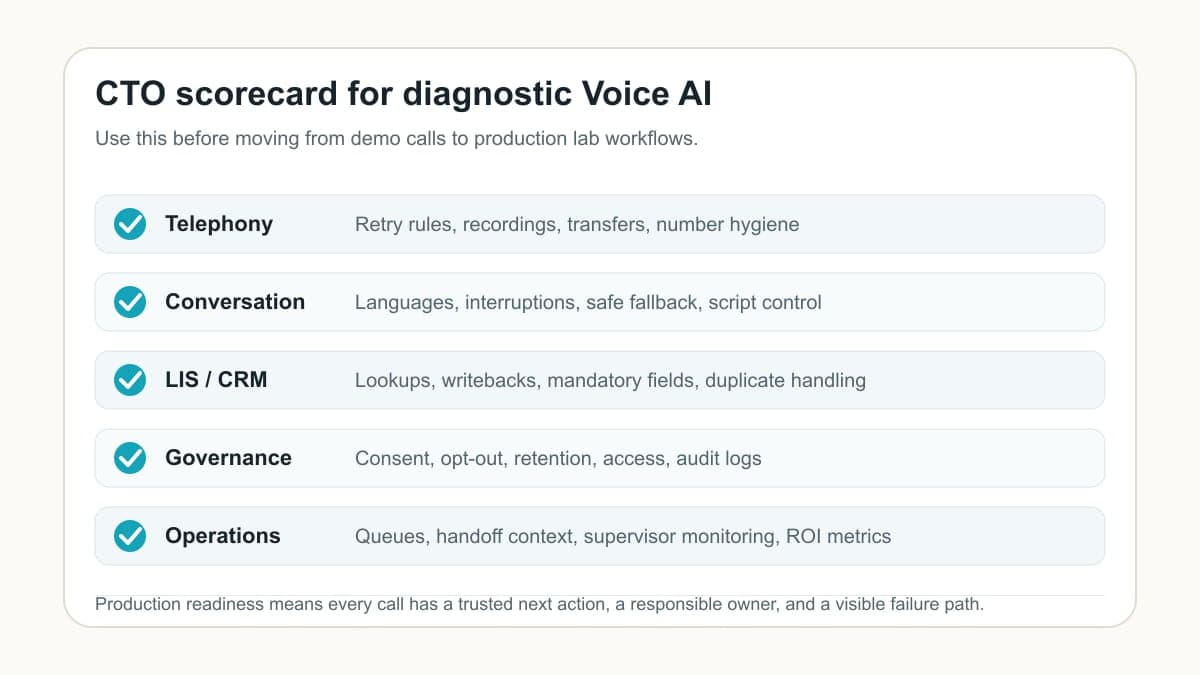
A useful Voice AI architecture for diagnostic labs usually has five layers. The first is telephony: incoming calls, outbound calls, call recording policy, retry rules, and number management. The second is the conversation layer: speech recognition, language handling, interruption tolerance, script logic, and safe fallback. The third is the integration layer: APIs, webhooks, CRM fields, LIS lookups, slot creation, and WhatsApp triggers.
The fourth layer is the operations layer: dispositions, task assignment, queue routing, transfer rules, and supervisor visibility. The fifth is the governance layer: consent, access control, logs, monitoring, analytics, and failure alerts. If a vendor only talks about speech quality, the CTO should push deeper. The voice is the interface; the architecture is the product.
A strong implementation also defines what the agent will not do. It should not interpret medical results, provide clinical advice, or promise availability without system confirmation. It should not expose report details without proper identification. It should not guess a slot, branch, price, or package inclusion when the source system is unavailable.
How to measure whether it is working
The right metrics depend on the workflow, but diagnostic labs should move beyond “number of calls handled”. For home collection, measure confirmed slots, incomplete booking reasons, route-ready requests, reschedule rate, and human intervention rate. For report queries, measure resolved status enquiries, safe handoffs, repeat calls, and complaint escalations. For package campaigns, measure qualified interest, callback completion, WhatsApp follow-up delivery, and conversion to booked test.
CRM quality should be measured separately. Are mandatory fields filled? Are dispositions useful? Are callbacks assigned to the correct queue? Are duplicate leads merged or flagged? Are failed calls retried according to policy? Are human teams seeing call summaries they can trust? These questions matter because a Voice AI Agent can create operational value only when the next action is clean.
Founders and CEOs should also review cost per useful outcome. A low per-minute cost is not meaningful if the lab still needs people to clean the data. A higher-quality workflow may cost more per call but reduce missed opportunities, repeat enquiries, manual tagging, and patient frustration. The commercial metric should be cost per confirmed booking, cost per resolved query, or cost per qualified follow-up.
Where humans still matter
Diagnostic labs should not use Voice AI to remove humans from every patient conversation. Humans are still better for complaints, medical interpretation, anxious patients, corporate negotiation, unusual test combinations, VIP accounts, and calls where the patient is confused or upset. The goal is not to hide human support. The goal is to reserve it for moments where judgement and empathy matter.
The handoff must be designed before launch. The human team should receive the caller context, intent, attempted resolution, captured fields, and reason for transfer. If the Voice AI Agent says “I will transfer you” but the human receives no context, the patient has to repeat everything. That is not automation; it is a poor queueing experience.
Where Xtreme Gen AI fits
Xtreme Gen AI builds Voice AI Agent workflows for real production environments, not only demos. For diagnostic labs, that means connecting call logic to the operational systems that matter: LIS, CRM, telephony, WhatsApp follow-ups, callback queues, home collection slots, report-query flows, and supervisor monitoring.
The implementation starts by mapping the workflow. Which calls should be automated first? Which fields are mandatory? Which systems are the source of truth? What should be written back to CRM? When should a human take over? What should happen when an API fails? These questions are answered before scale, because they decide whether the AI creates value or creates cleanup work.
If you want to experience how a Voice AI Agent handles a real conversation, you can call 9228034172. The point is not only to hear the voice. Listen for how the conversation captures intent, confirms next steps, and moves the workflow forward.
Conclusion
Voice AI for diagnostic labs should not be bought as a talking layer. It should be bought as an operational system that turns calls into clean lab actions. The call script matters, but the integration model decides whether patients get faster answers, teams get cleaner queues, and management gets trustworthy reporting.
For CTOs and founders, the best question is not “Can the AI talk?” The better question is “Can this Voice AI Agent safely connect patient intent to LIS, CRM, booking, report, consent, and handoff workflows at production volume?” If the answer is yes, the lab gains more than call automation. It gains a cleaner front door for patient operations.
Frequently Asked Questions
1. How should a diagnostic lab integrate Voice AI with LIS and CRM without corrupting operational data?
Start with a field-level workflow map. The LIS should remain the source of truth for orders, samples, tests, and report status, while the CRM should hold caller intent, callback tasks, commercial follow-up, and service context. The Voice AI Agent should read and write only approved fields, use validation rules, and route uncertain cases to humans instead of guessing.
2. What are the best first use cases for Voice AI in a diagnostic lab?
The strongest first use cases are structured and high-volume: home sample collection requests, report status queries, missed-call recovery, callback scheduling, preventive health package enquiries, and corporate health-check confirmations. These workflows are easier to measure and usually create cleaner ROI than trying to automate complex medical conversations first.
3. What should CTOs check before buying an AI calling agent for diagnostic labs?
CTOs should check telephony reliability, language handling, LIS and CRM API access, mandatory field mapping, consent capture, opt-out handling, report-query safeguards, call recording policy, human handoff, API failure behaviour, monitoring dashboards, and audit logs. A natural demo call is useful, but production readiness depends on these controls.
4. Can Voice AI handle diagnostic report queries safely?
Yes, but only with clear identity checks, limited status responses, and strict handoff rules. A Voice AI Agent can tell a patient whether a report is pending, ready, or needs human follow-up if that status is safely available from the system. It should not interpret medical results or reveal sensitive details without the lab’s approved policy.
5. How do diagnostic labs measure ROI from Voice AI call automation?
Measure outcomes, not only calls handled. Track confirmed home collection slots, resolved report-status enquiries, recovered missed calls, qualified package enquiries, callback completion, repeat-call reduction, CRM field completeness, human intervention rate, and cost per useful outcome such as confirmed booking or resolved query.