Highlights
- Highlights
- Why online degree enquiries need a different admissions workflow
- What the Voice AI Agent should ask on the first call
- The CRM should capture decision context, not only call status
- Why WhatsApp follow-up should be linked to the call outcome
- Where humans should still own the conversation
- What CTOs should check before integrating Voice AI
- What CMOs and founders should measure
- Where Xtreme Gen AI fits
- Conclusion

AI Voice Agents for Online Degree Enquiries: How Education Teams Can Qualify Serious Learners Faster
By Peush Bery
Published: June 23, 2026
Online degree and distance-learning enquiries are not the same as a normal brochure download. A learner may be comparing an MBA, MCA, BBA, B.Com, certification pathway, university recognition, weekend schedule, fee plan, placement support, and whether the programme will be accepted by an employer. In many Indian households, the caller may also not be the only decision-maker. A parent, spouse, manager, or friend may influence the final choice.
That makes the first call extremely important. If the education team treats every online degree lead as a generic enquiry, counsellors spend time asking the same first questions repeatedly. If the first call is delayed, the learner keeps comparing options elsewhere. If the CRM only says “interested” or “callback,” the next counsellor still does not know whether the learner is serious, eligible, confused, price-sensitive, or waiting for family approval.
AI voice agents for online degree enquiries can help create a cleaner first-response layer. The Voice AI Agent can call fresh leads, understand the programme being considered, ask qualification questions, capture preferred learning mode, identify parent or employer involvement, trigger a WhatsApp summary, schedule a callback, and update CRM before a human counsellor enters the conversation.
Highlights
What education leaders should take away
- Online degree enquiries usually need more context than a simple course lead because recognition, eligibility, schedule, fees, and decision-maker involvement matter.
- UGC regulations for online and ODL programmes make learner support and structured programme delivery important, so admissions teams should not treat online learning as a loose sales script.
- SWAYAM’s official positioning around access, equity and quality shows why online learning demand is not limited to metro students or one language group.
- A Voice AI Agent should capture programme interest, learner background, city, language preference, eligibility, fee readiness, callback time, and human handoff reason.
- The output should not be only a transcript. The useful output is a CRM update, counsellor queue, WhatsApp follow-up, and next action.
- Human counsellors remain essential for programme fit, recognition questions, fee nuance, trust building, and final enrolment closure.
- The strongest model is Voice AI before counsellor, not Voice AI instead of counsellor.
Why online degree enquiries need a different admissions workflow
A short-term course enquiry is often about skill, price, batch timing, and placement outcome. An online degree enquiry can be heavier. The learner may be asking whether the programme is recognised, whether examinations are online or at centres, whether credits matter, whether the employer will value the degree, whether the schedule fits a job, and whether the family should support the decision.
This is why online degree admissions automation India workflows need more structure than a normal callback queue. If the counsellor starts every call from zero, the organisation loses productivity. If the CRM is weak, managers cannot see why learners are dropping. If the follow-up is not aligned to the learner’s real doubt, WhatsApp messages become generic brochures rather than helpful next steps.
UGC’s Open and Distance Learning Programmes and Online Programmes Regulations, 2020 lay down minimum standards for degrees and postgraduate programmes delivered through ODL and online modes. The same regulation discusses learner support, LMS-based participation monitoring, and online programme coordination. That matters for admissions teams because the buyer is not only buying a course. The learner is trusting the institution with a structured academic path.
What the Voice AI Agent should ask on the first call
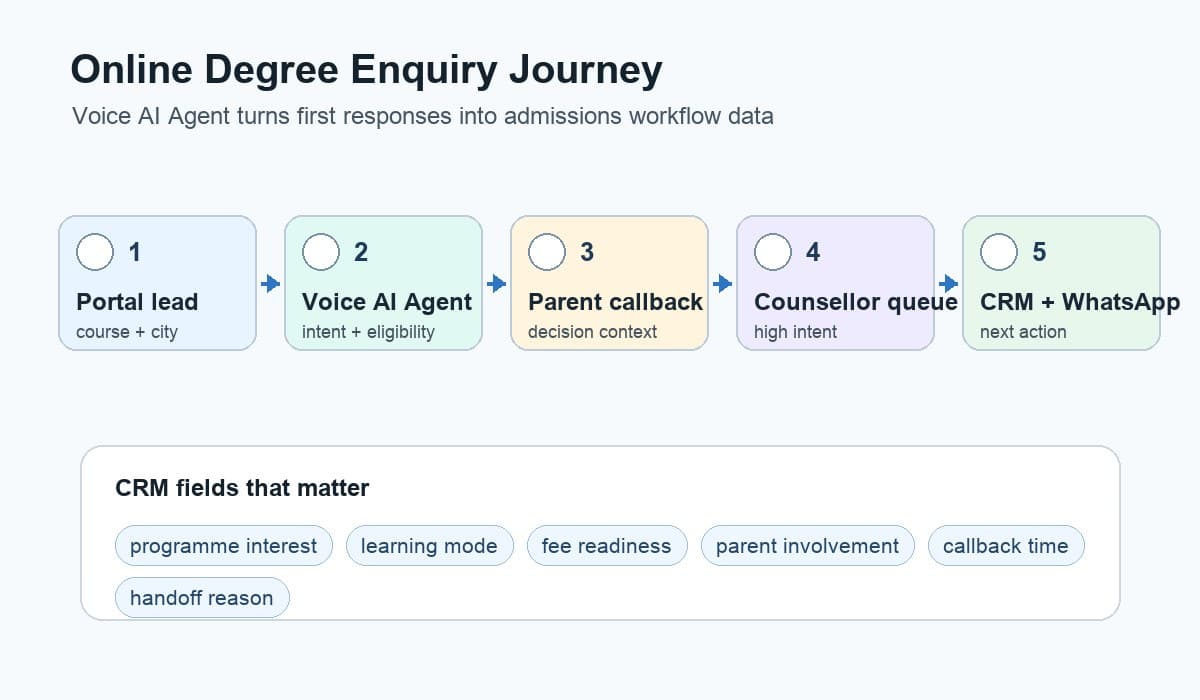
The first call should not sound like a hard-sell script. It should behave like a clean discovery conversation. The Voice AI Agent should confirm the learner’s programme interest, current education or work background, city, preferred learning schedule, urgency, budget sensitivity, and whether a parent or employer will be part of the decision.
For an online MBA enquiry, the agent may need to identify whether the learner is working, what kind of role they are in, whether weekend learning is preferred, and whether the learner wants career growth, a formal qualification, or a switch into a new function. For an online MCA or BCA enquiry, the agent may need to capture technical background, current education stage, and whether the learner is comparing degree and certification routes.
The important part is not to make the AI sound clever. The important part is to produce structured information that a counsellor can use. A human counsellor should not have to ask again which programme the learner wants, whether they are eligible, whether the parent should join the call, and when the learner is available.
The CRM should capture decision context, not only call status
Many education CRMs become noisy because call outcomes are too broad. “Interested,” “not interested,” “call later,” and “not reachable” do not tell the admissions head what is happening. Online degree teams need fields that explain the stage of the decision: programme interest, eligibility confidence, schedule fit, fee readiness, recognition doubt, parent involvement, city, language preference, preferred callback slot, and handoff reason.
This is where admissions CRM automation becomes valuable. A Voice AI Agent can turn the call into a clean record. It can trigger different follow-ups based on what the learner said. A learner asking about recognition should receive recognition-related approved material. A learner waiting for a parent should be tagged for a parent callback. A high-intent working professional should go to a counsellor queue with urgency.
For CMOs, this improves campaign reporting. They can see which ad sets bring serious online degree learners and which campaigns only create shallow enquiries. For CTOs and CPOs, it improves workflow reliability because the next system action is tied to structured fields instead of vague call notes.
Why WhatsApp follow-up should be linked to the call outcome
Online degree decisions rarely close inside one phone call. The learner wants material to read, a fee structure to compare, a university page to verify, or a family discussion before the next call. This is where Voice AI plus WhatsApp follow-up becomes useful. The call captures intent. WhatsApp carries the approved next step.
The mistake is sending the same brochure to every lead. If the learner asked about an online MBA while working full time, the message should not look like a generic course catalogue. If the learner asked about eligibility, the message should point to approved eligibility details. If the learner asked for a parent discussion, the message should prepare the callback rather than pretend the sale is ready to close.
SWAYAM’s official page describes the platform as a Government of India programme designed around access, equity and quality, and explains that courses are available free to learners while certification may involve a proctored exam fee. That context is important because Indian learners increasingly understand online education as a structured, credible learning path. Admissions teams need follow-up systems that respect that seriousness.
Where humans should still own the conversation
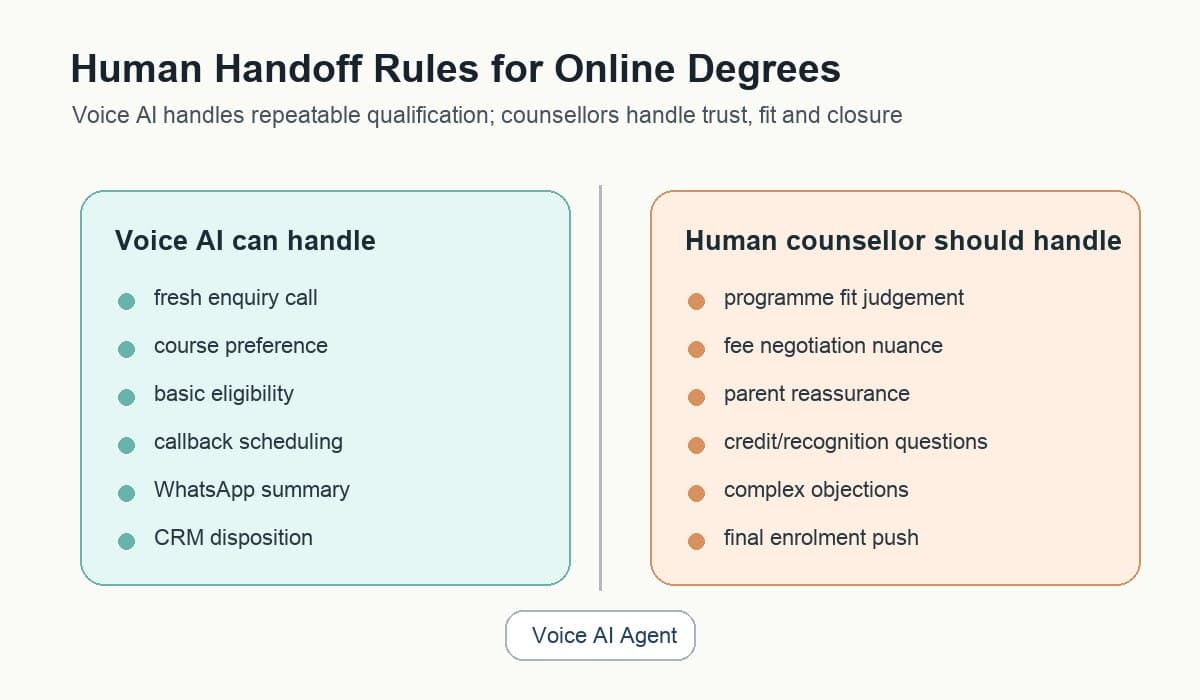
Voice AI should not replace the judgement-heavy part of online degree counselling. A human counsellor should handle programme fit, recognition nuance, career suitability, fee negotiation, scholarship explanation, family reassurance, complex objections, and final enrolment closure. These are trust moments. They require empathy, context, and judgement.
The Voice AI Agent should protect human time by doing the repeatable layer before counselling begins. It should classify the enquiry, capture the right fields, identify whether the lead is serious, send approved follow-up, and route the learner to the right counsellor with context. That makes the counsellor better, not less relevant.
What CTOs should check before integrating Voice AI
For CTOs, the main question is not whether the AI can complete one demo call. The question is whether the system can integrate cleanly with the admissions CRM, campaign source, telephony stack, WhatsApp provider, callback scheduler, and reporting layer. The Voice AI Agent should also support business-controlled scripts and safe escalation rules, because online degree campaigns change often.
The agent should handle interruptions, mixed language, noisy mobile calls, repeated questions, partial answers, and non-linear conversations. It should also record what it did in structured form: call result, lead status, programme interest, next action, callback time, transfer reason, WhatsApp trigger, and counsellor queue. Without this operational layer, the AI call may sound impressive but fail in production.
For regulated or academically sensitive questions, the system should be conservative. It should only use approved information, avoid making recognition claims beyond what the institution has provided, and hand off to a human counsellor when the learner asks for judgement, exceptions, or detailed academic advice.
What CMOs and founders should measure
For CMOs, AI voice agents for online degree enquiries should be judged by funnel quality, not call volume alone. Useful metrics include speed-to-first-call, connection rate, qualified enquiry rate, parent callback rate, WhatsApp follow-up completion, counsellor handoff rate, booking rate, enrolment conversion, and CRM completeness.
Founders should also watch whether counsellor time is being used better. If counsellors spend less time chasing weak leads and more time speaking to serious learners, the system is doing its job. If managers can see why learners are not moving forward, the system is creating business intelligence rather than just more calling activity.
The goal is not to call every online degree lead forever. The goal is to make the first response disciplined, capture context early, and send the right learners to humans faster. That is how Voice AI for course admissions becomes an operating workflow instead of another automation experiment.
Where Xtreme Gen AI fits
At Xtreme Gen AI, we build Voice AI agents for real admissions workflows, not only demo conversations. For online degree and distance-learning enquiries, the agent can qualify programme interest, capture learner background, identify parent or employer involvement, schedule callbacks, trigger WhatsApp follow-ups, update CRM dispositions, and route high-intent learners to counsellors.
We also focus on the production details that decide whether Voice AI succeeds after launch: telephony quality, CRM integration, callback logic, campaign-source tracking, language handling, safe human handoff, monitoring, and workflow tuning. If you want to experience the Voice AI Agent directly, call 9228034172.
Conclusion
Online degree enquiries need speed, but they also need structure. A learner choosing an online degree is often making a serious academic and career decision. The admissions team has to understand intent, eligibility, family context, schedule fit, fee readiness, and the right next step.
A Voice AI Agent can create that first layer with consistency. It can call quickly, ask the right questions, update CRM, trigger WhatsApp, and route serious learners to humans. For education companies selling online degrees, the best use of Voice AI is not replacing counsellors. It is giving counsellors better conversations to begin with.
Frequently Asked Questions
1. How can AI voice agents qualify online degree enquiries before counsellors call?
AI voice agents can ask about programme interest, current education or work background, eligibility, city, learning schedule, fee readiness, parent or employer involvement, and preferred callback time. The useful output is a structured CRM update and counsellor handoff, not just a transcript.
2. What CRM fields should an education team capture for online degree admissions automation?
Useful CRM fields include programme interest, learner background, city, language preference, eligibility confidence, learning mode, fee readiness, recognition doubt, parent involvement, WhatsApp follow-up sent, callback slot, lead score, and human handoff reason.
3. Can Voice AI handle recognition or eligibility questions for online degree programmes?
Voice AI can share approved institution-provided information and route the learner to the right counsellor when the question needs judgement. It should not invent recognition claims, interpret regulations, or answer exceptions beyond approved content.
4. How should CMOs measure ROI from Voice AI for online degree enquiries?
CMOs should measure speed-to-first-call, connection rate, qualified enquiry rate, counsellor handoff rate, WhatsApp completion, callback completion, CRM completeness, cost per qualified lead, and final enrolment conversion from campaigns.
5. Where should human counsellors take over in online degree enquiry workflows?
Human counsellors should take over for programme fit, career suitability, fee negotiation, scholarship discussion, recognition nuance, family reassurance, complex objections, and final enrolment closure. Voice AI should prepare the conversation before the counsellor joins.