Highlights
- By Peush Bery, Xtreme Gen AI
- Highlights
- Why pre-test preparation is an operations problem
- What the Voice AI Agent should say and capture
- Why WhatsApp should support the voice call
- Consent, privacy, and responsible calling
- NABL-style quality thinking before the sample reaches the lab
- The workflows to automate first
- What founders and CMOs should measure
- Where humans still matter
- Where Xtreme Gen AI fits
- Conclusion

Voice AI for Pre-Test Instruction Calls: Helping Diagnostic Labs Reduce Failed Visits
By Peush Bery
Published: June 29, 2026
By Peush Bery, Xtreme Gen AI
Diagnostic labs usually discuss call automation around bookings, report queries, or missed calls. But one of the most practical use cases sits just before the visit: pre-test instruction calls. These are the calls that remind a patient about fasting, timing, medication restrictions if applicable, sample collection readiness, address confirmation, home visit windows, and what to keep ready before the phlebotomist arrives.
When this step is weak, the lab does not always see it as a marketing problem. It appears as failed home visits, repeat calls, reschedules, sample rejection risk, delayed reports, confused patients, and operations teams chasing basic information. The patient may have booked the test, but the workflow still fails because the preparation was unclear or the reminder came too late.
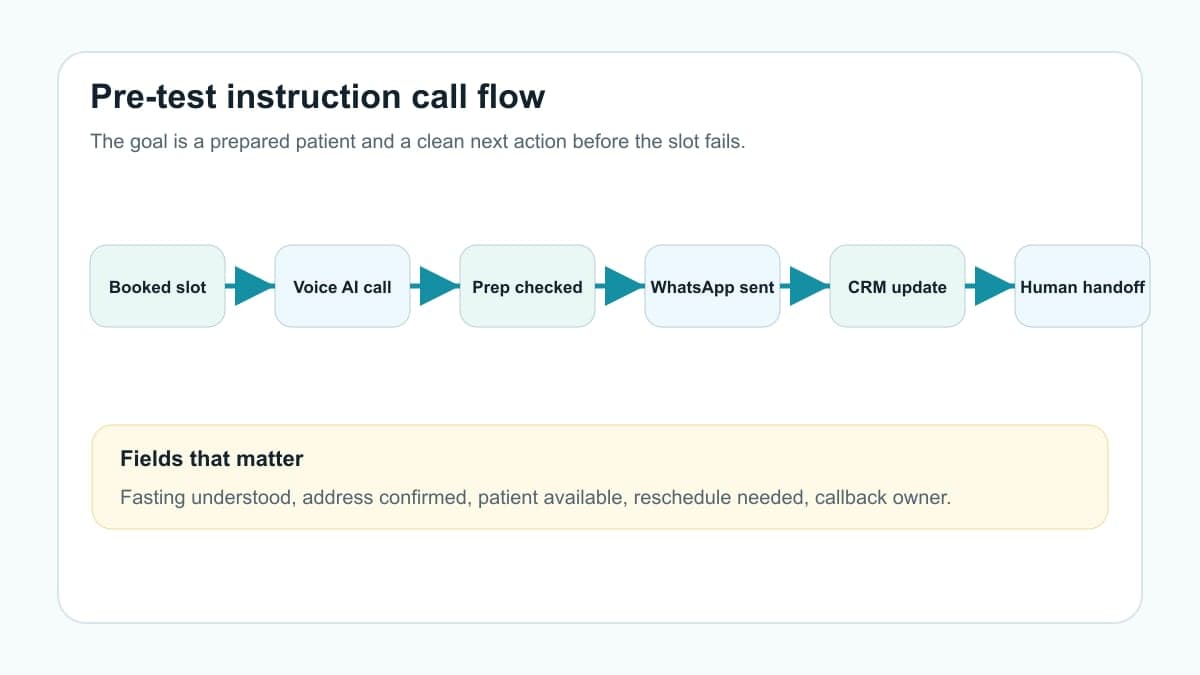
Voice AI for diagnostic labs can make this stage more reliable. A Voice AI Agent can call patients before the appointment, explain approved instructions, confirm the slot, capture readiness, send a WhatsApp reminder, update CRM or operations, and transfer exceptions to humans. The goal is not to give medical advice. The goal is to make sure the patient arrives prepared and the lab team knows which appointments need attention.
Highlights
What diagnostic leaders should take away
- Pre-test instruction calls are different from sales calls because the patient has already booked or shown strong intent.
- The Voice AI Agent should confirm timing, location, fasting requirement, sample readiness, callback need, and human handoff reason.
- Clear reminders can reduce operational waste from missed home visits, unprepared patients, repeat calls, and rescheduling.
- Instructions should come from approved lab knowledge, not AI improvisation.
- DPDP and TRAI make consent, opt-out handling, retry discipline, and recording access important for patient calls.
- NABL-style quality thinking supports structured process control before the sample reaches the lab.
- The strongest workflow combines voice reminders, WhatsApp follow-up, CRM disposition, smart retry logic, and human escalation.
- The business metric should be prepared visits and completed collections, not only calls handled.
Why pre-test preparation is an operations problem
A diagnostic lab can spend heavily to generate enquiries and confirm bookings, but still lose efficiency if patients are not ready at the point of collection. Some patients forget fasting requirements. Some are unavailable when the phlebotomist arrives. Some do not keep a prescription, ID, previous report, or payment method ready. Some need a human to clarify whether a test can happen at the chosen time.
These are not always large failures individually. But across hundreds or thousands of calls, they create pressure on front desk teams, collection coordinators, phlebotomists, and customer support. The same basic questions repeat: “Do I need to fast?”, “When will the person come?”, “Can I drink water?”, “Can I reschedule?”, “What should I keep ready?”
Pre-test instruction calls solve a different problem from lead qualification. They protect operational throughput after intent is already created. That is why the call design should be precise, controlled, and tied to the appointment or order context.
What the Voice AI Agent should say and capture
The Voice AI Agent should not invent instructions. It should use approved lab knowledge mapped to the test, package, collection type, and appointment context. For some tests, the instruction may be simple. For others, the safe response may be to transfer to a human or ask the patient to confirm with the lab team.
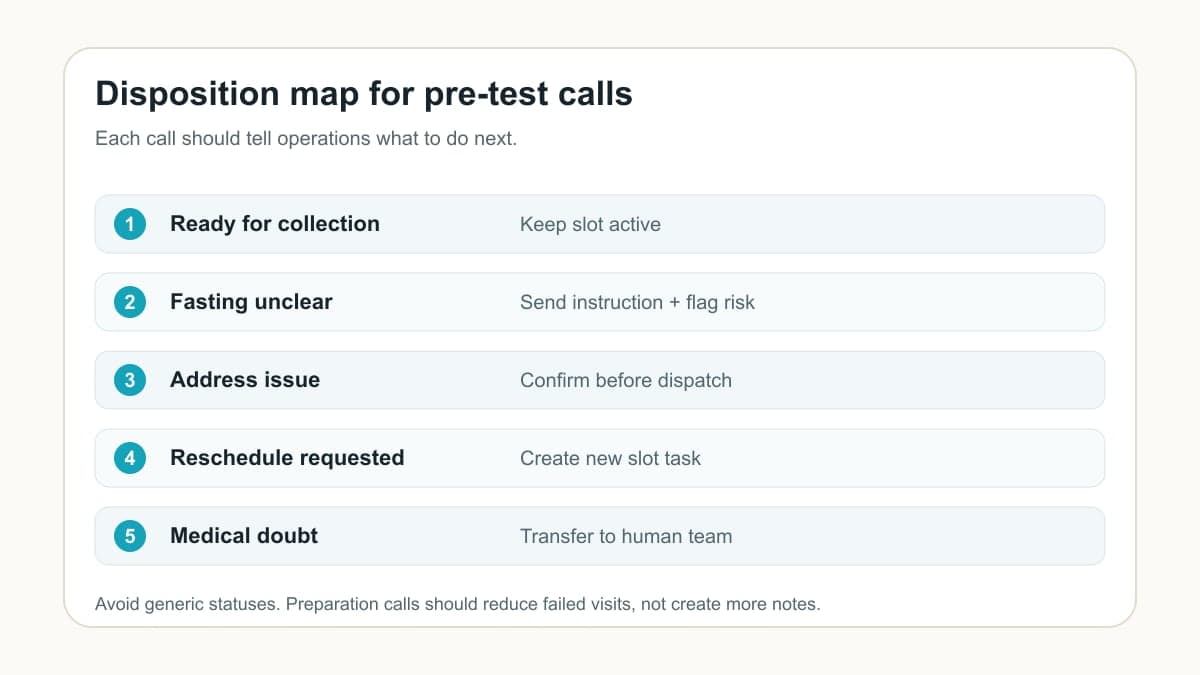
The call should capture structured fields: appointment confirmed, fasting understood, address confirmed, patient available, sample type if relevant, reschedule requested, WhatsApp reminder sent, callback required, and human escalation reason. If the patient says they are unavailable, the system should not mark the call as a generic “not connected” or “callback”. It should create the right operational next action.
This is where diagnostic CRM automation matters. Operations teams need to know which patients are ready, which slots are at risk, and which cases need human intervention. A transcript is useful, but the immediate value is the disposition and next action.
Why WhatsApp should support the voice call
A spoken reminder is useful, but patients often need a written checklist after the call. WhatsApp is natural for this workflow because the instruction can be sent in a simple format: fasting note, appointment window, address confirmation link, documents to keep ready, or support contact.
The important part is continuity. If the patient replies to the WhatsApp reminder and later receives another call, the Voice AI Agent should know that history. If the patient says “I already rescheduled”, the system should not behave as if nothing happened. Shared memory between voice and WhatsApp reduces repeated context collection.
For diagnostic labs, this also helps management reporting. Instead of seeing voice calls and WhatsApp reminders as separate campaigns, the team can see one preparation workflow: call made, instruction understood, reminder sent, address confirmed, slot at risk, human owner assigned.
Consent, privacy, and responsible calling
Pre-test instruction calls involve personal data and sometimes health-related context. The Digital Personal Data Protection Act, 2023, makes notice, consent, purpose limitation, retention, and access control important when processing patient information. A Voice AI Agent should therefore be configured around approved data access, recording policy, transcript visibility, and retention rules.
TRAI’s commercial communication framework also reinforces the need for responsible calling. Even when the call is service-related, labs should respect patient preference, callback timing, and opt-out instructions. Good automation should not mean calling the patient repeatedly without context.
The practical rule is simple: if a patient asks for a later callback, call later. If a patient says the slot is cancelled, update the workflow. If a patient asks not to be contacted, capture that preference. Smart retry logic is not only a conversion feature; it is part of patient experience.
NABL-style quality thinking before the sample reaches the lab
NABL accreditation for medical laboratories is associated with competence and quality systems. A Voice AI Agent does not replace laboratory quality control, but it can support the pre-analytical discipline around patient readiness, sample timing, collection instructions, and communication clarity.
Many lab-quality problems begin before analysis. If a patient is unprepared, if a sample cannot be collected, if the wrong slot is assumed, or if the patient misunderstands the instruction, the operational issue has already started. Pre-test instruction calls give labs a controlled way to reduce ambiguity before the appointment.
This is why the workflow should be governed. Approved scripts, exception rules, escalation triggers, and audit trails are not overengineering. They protect the lab from inconsistent communication at scale.
The workflows to automate first
The best starting point is not every possible test. Start with high-volume, repeatable workflows where instructions are clear and measurable. These may include preventive health packages, fasting blood tests, early morning home sample collection, corporate health-check slots, repeat appointment reminders, or reschedule confirmation calls.
The lab should define when the AI can complete the call and when it must escalate. For example, if the patient asks a clinical question, reports a medical complication, disputes a package inclusion, or requests a special exception, the Voice AI Agent should route to a human. The purpose is reliable preparation, not medical judgement.
Once the first workflow is stable, the lab can expand to more categories. The same infrastructure can support home collection reminders, report-query callbacks, package renewals, and CRM-based patient follow-ups.
What founders and CMOs should measure
The most useful metric is not call volume. It is appointment readiness. Labs should track confirmed slots, address confirmations, reschedules captured before dispatch, patients marked ready, WhatsApp reminder delivery, human escalation rate, missed collection reduction, and repeat-call reduction.
CMOs should also watch campaign quality at the preparation stage. If one channel produces many bookings but many unprepared patients, the campaign may look good at the lead stage but weak at the operations stage. Voice AI can help reveal this because every call outcome can be written back to CRM.
For founders and CEOs, the commercial question is whether the same operations team can handle more confirmed collections without adding more manual reminder calls. If the Voice AI Agent reduces failed visits and improves readiness, it directly supports throughput and patient experience.
Where humans still matter
Humans should remain involved whenever the patient is confused, anxious, medically uncertain, or asking for advice outside approved instructions. Humans are also better for complaints, complex rescheduling, corporate-account exceptions, special patient needs, and edge cases where the lab policy is not straightforward.
The right design is not AI instead of humans. It is AI before humans. The Voice AI Agent handles structured reminders, confirms readiness, records outcomes, and escalates exceptions with context. The human team receives cleaner information and spends less time asking basic questions repeatedly.
Where Xtreme Gen AI fits
Xtreme Gen AI builds managed Voice AI Agent workflows for production diagnostic teams. For pre-test instruction calls, this means custom call logic, approved instruction knowledge, retry rules, callback scheduling, CRM updates, WhatsApp reminders, call summaries, recordings, transcripts, smart memory, and human handoff.
The agent can be customised around each lab’s test categories, package instructions, home collection rules, branch timings, escalation policy, and reporting needs. Xtreme Gen AI also maintains the agent prompt, tool calling, QA, and improvements after launch, so the lab is not left managing a self-serve voicebot internally.
If you want to experience how a Voice AI Agent handles a real conversation, call 9228034172. Listen for how the agent captures context, confirms next steps, and moves the workflow forward.
Conclusion
Pre-test instruction calls are not glamorous, but they are valuable. They sit at the point where patient intent becomes operational execution. If the patient is prepared, the lab visit or home collection is smoother. If the patient is confused or unavailable, the lab can intervene before the slot fails.
For diagnostic founders, CMOs, CPOs, and CTOs, this is a practical use case for Voice AI for diagnostic labs. The goal is simple: fewer failed visits, cleaner preparation data, better patient communication, and more useful work for human teams.
Frequently Asked Questions
1. How can Voice AI help diagnostic labs with pre-test instruction calls?
Voice AI can call patients before a lab visit or home sample collection, confirm the appointment, explain approved fasting or preparation instructions, send a WhatsApp reminder, capture readiness, update CRM, and escalate exceptions to a human team.
2. What should a Voice AI Agent capture before a diagnostic lab appointment?
Useful fields include appointment confirmation, fasting understood, address confirmed, patient availability, reschedule request, WhatsApp reminder sent, callback need, slot-at-risk status, and human handoff reason. These fields help operations teams act before the visit fails.
3. Can AI give fasting instructions for diagnostic tests safely?
Yes, if the Voice AI Agent uses only approved lab instructions and clear escalation rules. It should not improvise medical advice. If the patient asks a clinical question, mentions a complication, or needs an exception, the call should be routed to a human.
4. How should diagnostic labs measure ROI from pre-test reminder calls?
Track prepared visits, confirmed slots, reschedules captured before dispatch, missed collection reduction, repeat-call reduction, WhatsApp reminder completion, human escalation rate, and operational time saved from manual reminder calling.
5. Should pre-test instruction calls be handled by humans or Voice AI?
The strongest model is Voice AI before humans. AI handles repeatable reminders and readiness checks, while humans handle medical doubts, complaints, special cases, anxious patients, and exceptions. This protects human time without weakening patient support.