Highlights
- By Peush Bery, Xtreme Gen AI
- Highlights
- Why prescription-led bookings stall
- Prescription upload follow-up needs clear boundaries
- What the Voice AI Agent should capture
- Why WhatsApp and voice should work together
- Where compliance and quality matter
- How founders and CMOs should measure the workflow
- What should still go to humans
- Where Xtreme Gen AI fits
- Conclusion

Voice AI for Prescription Upload Follow-Ups: Helping Diagnostic Labs Complete Test Bookings
By Peush Bery
Published: June 30, 2026
By Peush Bery, Xtreme Gen AI
Diagnostic labs often receive serious patient intent in an incomplete form. A patient may have spoken to a doctor, received a prescription, searched for a lab, filled a form, sent a WhatsApp message, or called the branch. But the lab still cannot move the case forward because the prescription image is missing, unclear, incomplete, or not mapped to the right test booking workflow.
This is a small operational gap with a real revenue impact. The patient has intent, but the lab team still needs to confirm what the doctor has advised, whether the prescription has been uploaded, whether fasting or preparation is needed, whether home collection is required, and whether a human should review the prescription before the booking is finalised.
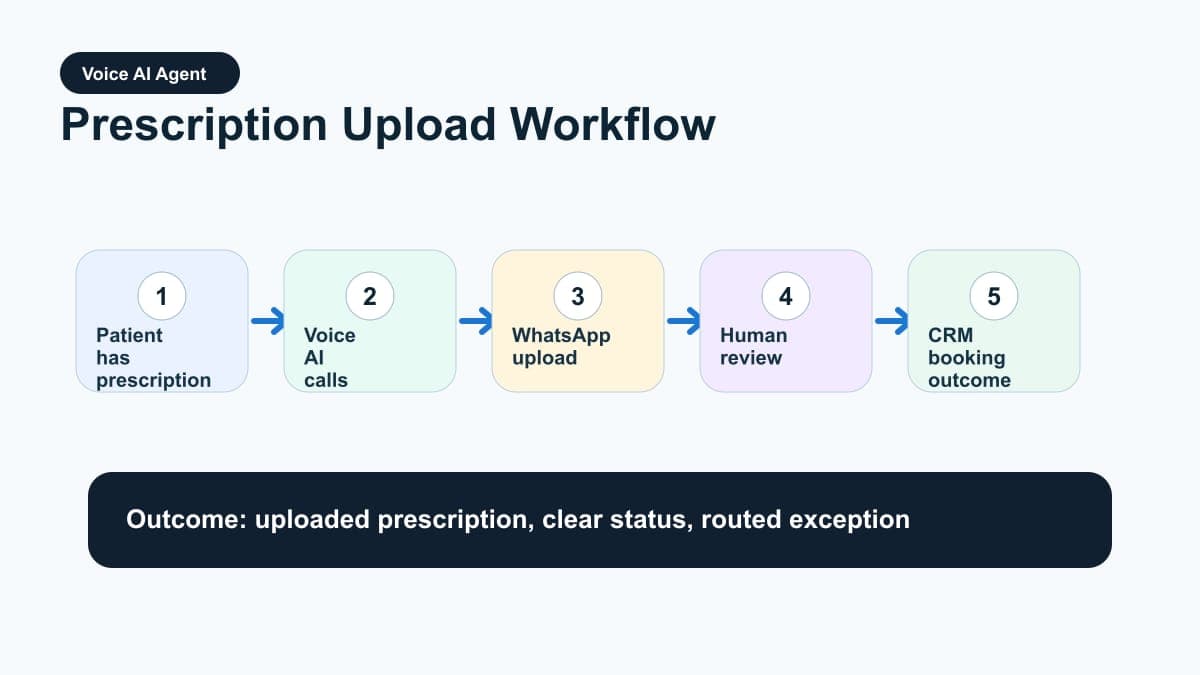
Voice AI for diagnostic labs can make prescription upload follow-ups more disciplined. A Voice AI Agent can call the patient, ask whether the prescription has been shared, trigger a WhatsApp upload link, confirm basic booking details, update CRM, schedule a callback, and route exceptions to a human lab team. The AI should not interpret medical advice on its own. It should help the lab collect the right input and move the workflow to the right person.
Highlights
What diagnostic leaders should take away
- Prescription upload follow-up is different from a generic enquiry call because the patient may already have doctor-directed intent.
- The Voice AI Agent should collect the prescription status, test category, location, home collection need, callback time, and exception reason.
- Labs should not let AI interpret prescriptions medically unless the workflow has approved rules and human review where needed.
- NABL's ISO 15189 context reinforces why diagnostic workflows need traceability and process discipline.
- DPDP 2023 makes prescription images, recordings, transcripts, and patient CRM data a serious governance matter.
- TRAI's 2018 commercial communication rules make consent, opt-out, and retry logic important for outbound patient calls.
- The strongest workflow combines calling, WhatsApp upload links, CRM dispositions, human review, callback scheduling, and reporting.
- The business metric should be completed test bookings and clean handoffs, not only calls attempted.
Why prescription-led bookings stall
Prescription-led diagnostic demand is usually high intent. The patient is not simply browsing packages. In many cases, a doctor has advised tests and the patient wants to know where to book, what it will cost, whether the lab can collect from home, and how soon the report will be ready. Yet these bookings still stall because the lab does not receive a usable prescription at the right time.
The failure is often mundane. The patient forgets to upload the image. The WhatsApp message lands with no branch or patient context. The uploaded photo is blurry. The front desk is unsure which tests are included. A phlebotomist slot is needed but not confirmed. The patient asks whether fasting is required. The lab team wants a human to verify the prescription before committing on price or preparation.
If the lab handles all of this manually, the team spends time chasing patients, reading old notes, asking the same questions again, and updating CRM late. If the lab ignores it, a serious booking can move to another provider. Prescription upload follow-up is therefore not a minor reminder; it is a conversion and operations workflow.
Prescription upload follow-up needs clear boundaries
A Voice AI Agent should not pretend to be a doctor or a medical reviewer. The safe workflow is narrower and more useful. The agent can remind the patient to upload the prescription, confirm whether the patient wants home collection or branch visit, capture preferred time, ask if a human callback is needed, and send the upload link on WhatsApp.
Once the prescription is received, the workflow can route it to the right team for review or mapping. For simple cases, the lab may have approved rules for next steps. For unclear prescriptions, handwritten notes, missing doctor details, unusual combinations, or patient questions that need judgement, the Voice AI Agent should create a human task instead of improvising.
What the Voice AI Agent should capture
The most useful fields are operational. Has the prescription been uploaded? Is the image clear? Does the patient want home collection or branch visit? What is the patient location? What time works for the callback or collection? Does the patient want pricing before booking? Is there a fasting or preparation question? Does a human need to verify the prescription before confirmation?
These fields should become structured CRM dispositions, not vague notes. Useful dispositions include prescription pending, prescription uploaded, image unclear, human review required, WhatsApp link sent, home collection requested, branch visit preferred, callback scheduled, patient not reachable, and duplicate enquiry. Managers can then see where bookings are stuck instead of only seeing call volume.
For CTOs and CPOs, this is where API and CRM design matters. The Voice AI Agent should read the patient record before calling, understand the current stage, trigger WhatsApp when needed, write back the next action, and avoid calling again when the retry limit or opt-out rule says stop.
Why WhatsApp and voice should work together
Prescription upload is rarely solved by voice alone. The call is good for urgency, clarity, and confirmation. WhatsApp is better for sending the upload link, receiving the image, sharing basic instructions, and keeping the patient record connected to the conversation. If the two channels do not share memory, the patient experience breaks.
A strong workflow lets the Voice AI Agent call first, then send a WhatsApp link during or after the call. If the patient uploads the prescription, the CRM stage changes. If the image is unclear, the system can ask for a clearer image or route to the lab team. If the patient calls back, the incoming agent should know the earlier conversation instead of starting from zero.
Where compliance and quality matter
Prescription images and patient conversations are sensitive personal data. The Digital Personal Data Protection Act, 2023 makes notice, purpose limitation, consent, retention, and responsible processing important for organisations handling patient data. Labs should decide what data is collected, why it is collected, who can access it, and how long it is retained.
TRAI's Telecom Commercial Communications Customer Preference Regulations, 2018 are also relevant because labs cannot treat outbound calling as an uncontrolled activity. Consent, opt-out handling, retry rules, time windows, and suppression logic should be part of the calling workflow. A production Voice AI system should make those rules configurable and auditable.
NABL's medical laboratory context, including medical laboratories as per ISO 15189, is a useful reminder that diagnostic workflows require discipline before and after the sample. Voice AI should support that discipline by creating traceable actions, clean records, and human review paths where the prescription or patient query needs judgement.

How founders and CMOs should measure the workflow
For founders and CMOs, the first metric is not how many calls the AI completed. The better metric is how many prescription-led enquiries became complete test bookings. That means tracking prescription upload rate, clear-image rate, WhatsApp upload completion, human review queue, home collection confirmation, callback completion, and booking conversion after prescription review.
This also helps diagnose campaign quality. If a campaign brings many prescription-led enquiries but very few prescriptions get uploaded, the problem may be in the form, WhatsApp journey, call timing, or branch follow-up. If prescriptions are uploaded but not reviewed quickly, the bottleneck is operations. Voice AI helps only when the reporting shows where the bottleneck sits.
What should still go to humans
Humans should handle interpretation, exceptions, and trust-heavy conversations. If a patient asks whether a test is medically necessary, whether one test can replace another, whether medication should be stopped, or whether symptoms require urgent attention, the AI should not answer beyond approved scripts. It should route to a qualified human or ask the patient to consult the doctor.
The same applies when prescriptions are unclear, handwritten, incomplete, or conflicting. The Voice AI Agent can collect and route the information, but it should not make clinical commitments. The purpose of automation is to reduce repetitive coordination, not to remove human judgement from medical workflows.
Where Xtreme Gen AI fits
Xtreme Gen AI can build prescription upload follow-up workflows where voice, WhatsApp, CRM, callback scheduling, and human review work together. The Voice AI Agent can call patients from bulk upload or API triggers, send WhatsApp upload links, capture custom dispositions, schedule callbacks, and update the dashboard or CRM with summaries, recordings, transcripts, and next actions.
The platform supports smart memory across calls, incoming missed-call context, custom retry logic, live transfer, CRM/webhook integration, custom reporting, CSV download, and managed agent maintenance. For diagnostic labs, this means the AI agent is not only a conversation layer. It becomes part of the booking operations workflow.
If you want to hear how the Voice AI Agent sounds in practice, call 9228034172. It is a simple way to experience the flow before discussing a diagnostic lab workflow.
Conclusion
Prescription-led diagnostic bookings are valuable because the patient already has a reason to act. But if the lab does not collect the prescription, confirm the next step, and route exceptions quickly, that intent can leak.
Voice AI for diagnostic labs is strongest when it handles this coordination without pretending to be a medical expert. It can remind, collect, route, update, and escalate. That is exactly where many diagnostic teams need help: not replacing the lab team, but making sure serious patient intent reaches the right operational step.
Frequently Asked Questions
1. How can Voice AI help diagnostic labs with prescription upload follow-ups?
Voice AI can call patients who have not uploaded a prescription, send a WhatsApp upload link, confirm home collection or branch visit preference, capture callback timing, update CRM, and route unclear prescriptions to a human lab team.
2. Can a Voice AI Agent read and interpret doctor prescriptions for diagnostic labs?
The safer approach is for Voice AI to collect and route the prescription, not independently interpret medical advice. Clear rule-based cases may follow approved workflows, but unclear, handwritten, unusual, or judgement-heavy prescriptions should go to human review.
3. What CRM dispositions should labs track for prescription-led diagnostic bookings?
Useful dispositions include prescription pending, prescription uploaded, image unclear, WhatsApp link sent, human review required, home collection requested, callback scheduled, pricing requested, patient not reachable, and duplicate enquiry.
4. How should CMOs measure ROI from prescription upload automation in diagnostic labs?
CMOs should track prescription upload rate, upload completion after WhatsApp, clear-image rate, human review turnaround, completed bookings, home collection confirmations, and conversion from prescription-led enquiries to paid tests.
5. What compliance risks matter when diagnostic labs use AI calling for prescription follow-up?
Labs should define consent, opt-out handling, retry limits, call timing, recording access, prescription image storage, retention, and human review rules. Prescription images and patient conversations should be treated as sensitive personal data.