Highlights
- By CEO, Xtreme Gen AI
- Why the real sales problem is not lead volume, but lead prioritisation, response speed, qualification quality, CRM discipline, and human time leakage
- The old model: every lead goes directly to sales
- Why speed matters more than most teams admit
- The wrong question: can my sales team call these leads?
- All leads are not equal
- What Voice AI should do before sales gets involved
- How this works in real business workflows
- SMB view: why this matters for small and mid-sized businesses
- Enterprise view: why this matters even when you already have a calling team
- The real cost of calling every lead manually
- Why salespeople should not spend their best time on basic qualification
- Compare lead prioritisation, not only lead generation
- Where humans are still better
- Where Voice AI is clearly better
- What businesses should measure instead
- The better model: AI qualifies, humans close
- Where Xtreme Gen AI fits

Why Your Sales Team Should Not Call Every Lead First
By Peush Bery
Published: June 8, 2026
By CEO, Xtreme Gen AI
Why the real sales problem is not lead volume, but lead prioritisation, response speed, qualification quality, CRM discipline, and human time leakage
Most businesses say their sales team is overloaded. But in many cases, the real problem is not the sales team. The problem is that the sales team is being asked to call every lead first.
A serious buyer, a casual enquiry, a wrong-number lead, a duplicate form fill, a low-intent prospect, a callback request, a price-checking customer, and an unserviceable-location lead often enter the same sales queue. Then companies wonder why their best people are tired, follow-ups are delayed, CRM data is messy, and hot leads are not getting enough attention.
The job of a sales team is not to call every lead. The job of a sales team is to close the right leads.
That distinction is becoming extremely important for Indian businesses. SMBs usually have limited calling bandwidth, while enterprises may have larger teams but much higher lead volume, more channels, more regions, and more reporting pressure. In both cases, treating every lead equally creates leakage.
This is where Voice AI can change the sales workflow. Not by replacing salespeople, but by creating a first-response layer that qualifies, filters, organises, and routes leads before expensive human time is used.
The old model: every lead goes directly to sales
The traditional sales process is simple. A lead comes from a form, ad campaign, website, marketplace, WhatsApp, missed call, event, referral, or CRM upload. The sales team receives the lead. Someone calls. If the person does not answer, the lead is marked for follow-up. If the conversation happens, the salesperson asks basic questions, captures intent, updates CRM, and decides what to do next.
This model can work when lead volume is low. It breaks when lead volume increases.
In Indian SMBs, this breakage is often visible in very practical ways. Leads are called late. Some leads are never called. Salespeople keep their own notes outside CRM. Follow-ups depend on individual discipline. Campaign spikes create backlogs. Founders have to manually ask what happened to yesterday’s leads.
In enterprises, the same problem becomes more structured but not necessarily solved. There may be a CRM, dialer, calling team, QA process, and reporting dashboard. But sales leaders still struggle with speed-to-lead, duplicate handling, disposition quality, agent productivity, SLA breaches, and leakage between marketing and sales.
The uncomfortable truth is simple. When every lead is treated equally, hot leads get punished. They wait in the same queue as low-intent leads.
Why speed matters more than most teams admit
Lead response time is one of the biggest reasons good leads quietly become bad leads. When someone fills a form, asks for pricing, requests a callback, or clicks an ad, their intent is active at that moment. After some time, they may be in another meeting, speaking to a competitor, distracted, or no longer interested.
A well-known lead response study found that the odds of contacting a lead fall sharply as response time increases. The same research is often cited for the point that contacting a lead within the first five minutes can create a dramatically higher chance of qualification compared with delayed response.
The exact number will vary by industry, ticket size, lead source, and geography. But the business logic is clear. The faster a business responds while intent is fresh, the higher the chance that the conversation turns into a real opportunity.
For Indian businesses, this is even more important because many categories are highly competitive. Education, diagnostics, real estate, insurance, loans, automotive service, travel, dental, clinics, and local services all face the same issue. Customers often enquire with multiple providers and respond to whoever reaches them first with clarity.
So when the sales team is busy calling every lead manually, the real loss is not only labour cost. The real loss is delayed attention on high-intent leads.
The wrong question: can my sales team call these leads?
Most businesses ask whether their sales team can call all the leads. A better question is whether the sales team should be the first layer for all those leads.
Not every lead needs a human salesperson at the first step. Some leads only need qualification. Some need a callback time captured. Some need basic pricing information. Some need serviceability checked. Some need a WhatsApp brochure. Some need routing to the correct team. Some are duplicate, invalid, not reachable, or low intent. Some are serious enough to be transferred to a human immediately.
Putting all of these leads directly in front of salespeople is expensive, not only financially but operationally. It reduces the amount of time salespeople spend on conversations where human judgment actually matters.
This is not sales. This is lead triage.
And lead triage is exactly where Voice AI can help.
All leads are not equal
A lead is not a lead. That sounds obvious, but most sales queues do not behave that way.
In a typical Indian business, one campaign can produce many types of enquiries. A student looking seriously for admission this week. A parent asking only for fees. A patient checking whether home sample collection is available. A car owner asking for an estimated repair price. A travel lead comparing three destinations. A dental patient asking about EMI. A real estate buyer checking only location and price range. A loan lead who is not eligible. A wrong number. A duplicate lead. A person who says call me after 6 PM. A person who says send details on WhatsApp. A person outside the serviceable city. A person who wants to speak to a human immediately.
If all of them go directly to the same sales team, the team starts spending its best hours on basic sorting.
That is not the best use of human sales talent.
What Voice AI should do before sales gets involved
A production Voice AI agent should not try to behave like your best salesperson. That is the wrong expectation.
Its first job should be to create order before the human team steps in.
A Voice AI agent can call a new lead quickly, ask a few qualifying questions, identify the requirement, check basic eligibility or serviceability, capture callback timing, update CRM fields, trigger a WhatsApp message, and transfer hot leads to a human when needed.
In simple terms, Voice AI qualifies. Humans close.
This is a much more practical model than saying AI will replace salespeople. The better model is AI before human, not AI instead of human.
How this works in real business workflows
For an education company, the AI can check course interest, city, intake timeline, budget range, and preferred callback slot before sending the right leads to counsellors.
For a diagnostic lab, it can ask the test name, pincode, home collection preference, fasting requirement, and booking time before routing the lead to the right team.
For a travel company, it can capture destination, number of travellers, travel dates, budget range, and urgency before a travel expert spends time on the enquiry.
For an automotive service company, it can capture car model, service need, city, pickup requirement, and callback timing before a human advisor gets involved.
For a clinic, it can identify specialty, location, appointment preference, and whether the case is urgent before the front desk or care team spends time on the call.
For an enterprise sales team, it can separate demo requests, support queries, vendor calls, student or job enquiries, spam, and high-intent business leads.
The sales team should then spend time on the leads that actually deserve human judgment.
SMB view: why this matters for small and mid-sized businesses
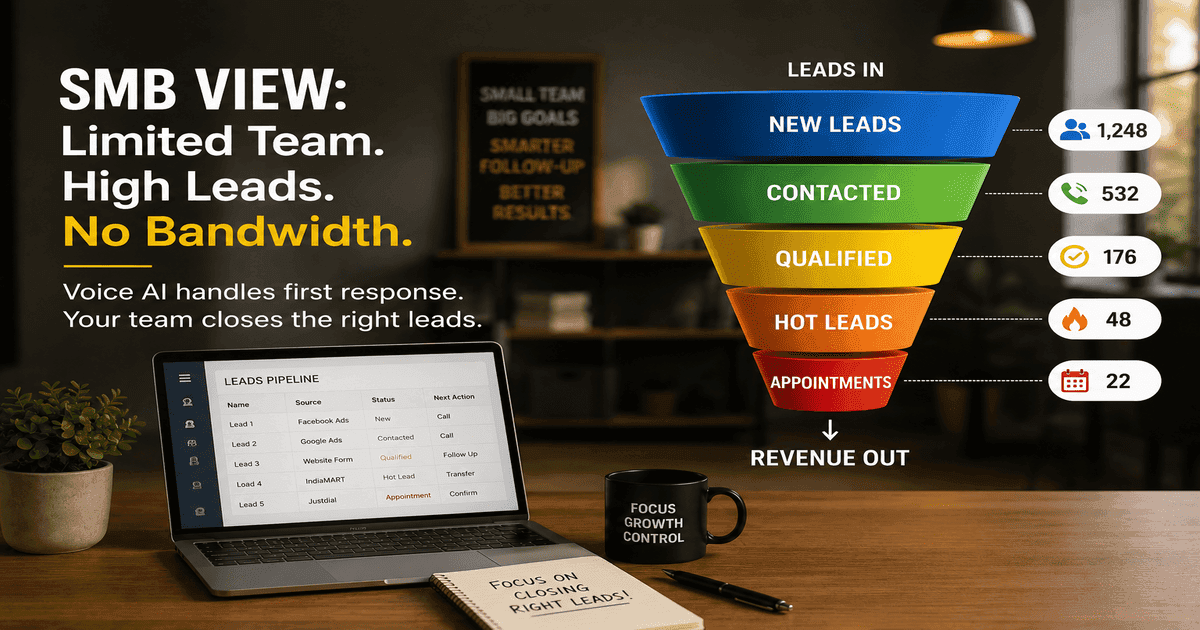
For SMBs, the problem is usually not sophisticated process design. The problem is bandwidth.
A small business may have one founder, one marketing person, two callers, and a small sales team. Paid ads are running. Leads are coming from Meta, Google, IndiaMART, website forms, referrals, Justdial, WhatsApp, and marketplace listings. But the follow-up system is still dependent on people manually checking sheets, calling from mobile phones, updating partial notes, and remembering who needs a callback.
In this environment, even a small delay hurts. SMBs cannot afford to hire large teams only to handle first response. They also cannot afford to waste ad spend on leads that are never called properly.
India has a very large base of MSMEs, and most of them operate with lean teams and limited sales capacity. For these businesses, a missed lead is not just a reporting issue. It is lost marketing money, lost founder time, and lost revenue opportunity.
For SMBs, Voice AI can act like a disciplined first-response team that does not forget, does not delay, does not skip leads, and does not leave CRM blank. It gives the founder or sales head a cleaner view of the pipeline.
The value is not only cost saving. The value is control.
Enterprise view: why this matters even when you already have a calling team
Enterprises often look at Voice AI differently. They may already have call center teams, inside sales teams, CRM systems, dialers, QA teams, and reporting dashboards. So the question is not whether they can make calls.
The better question is whether they can make the right calls faster, with cleaner data, across higher volume, without losing control.
In enterprise environments, the first-calling problem appears in different forms. Marketing generates thousands of leads during a campaign. Sales teams complain about poor lead quality. Call center teams complain about unreachable numbers. CRM teams complain about bad dispositions. Regional teams say leads are not routed correctly. Managers get reports, but the reports do not always explain what actually happened in the conversation.
A Voice AI layer can help enterprises standardise the first touch. Every lead can be called quickly. Every conversation can follow the same qualification logic. Every disposition can be structured. Every callback can be scheduled. Every hot lead can be routed. Every non-serviceable lead can be marked. Every missed attempt can be retried according to rules.
For enterprises, the strongest reason to use Voice AI before sales is not headcount reduction. It is process consistency at scale.
The real cost of calling every lead manually
The cost of manual first calling is usually underestimated because businesses only count salary.
But the real cost includes delayed response, missed attempts, low-quality dispositions, duplicate calling, poor CRM hygiene, manager follow-ups, retraining, attrition, uneven script quality, and opportunity loss from hot leads not being prioritised quickly.
In India, human callers may look inexpensive when compared only on monthly salary. But salary is only one part of the equation. A caller also needs supervision, training, QA, infrastructure, software access, reporting, and management bandwidth.
More importantly, a human caller has limited daily capacity. If one campaign suddenly generates thousands of leads, a human team cannot instantly expand for one day and then shrink the next day. This is where campaign spikes create leakage.
Voice AI is useful because it can absorb the first-response load quickly. It can attempt calls, classify outcomes, and send the right leads to the human team.
That changes the economics from cost per caller to cost per qualified conversation.
Why salespeople should not spend their best time on basic qualification
Human sales time is valuable when it is used on persuasion, counselling, objection handling, relationship building, negotiation, and closure. It is wasted when it is used repeatedly on basic sorting.
If a salesperson spends the first half of the day asking whether the lead is serious, whether the location is serviceable, whether the customer wants a callback, whether the customer has the budget, or whether the number is even valid, the business is using skilled sales time for low-skill filtering.
This does not mean the filtering is unimportant. It means the filtering should happen before the salesperson’s time is used.
A strong sales process should protect human time. Voice AI can do that by qualifying and organising leads before they reach the sales team.
Compare lead prioritisation, not only lead generation
Many Indian businesses spend heavily on lead generation but underinvest in lead prioritisation. They run ads, build landing pages, buy marketplace leads, collect forms, and push enquiries into CRM. But after that, the lead queue becomes messy.
A hot lead and a cold lead may receive the same treatment. A high-intent enquiry may wait behind a duplicate lead. A serious buyer may be called late because the team was busy with low-intent calls.
This is where businesses lose money quietly. They do not see it as leakage because the lead still exists in the CRM. But in reality, the lead’s intent has already started decaying.
Voice AI can help by creating a priority layer. It can mark who is interested, who wants a callback, who is not reachable, who needs WhatsApp, who is not eligible, who should be transferred, and who should stop receiving calls.
The business then gets a cleaner queue. Salespeople know where to spend time first.
Where humans are still better
Voice AI should not be positioned as better than humans in every situation. That would be wrong.
Humans are better when the conversation requires deep persuasion, emotional intelligence, negotiation, complex objections, relationship building, or trust-building. A high-ticket enterprise deal, a sensitive healthcare concern, an angry customer escalation, or a complex financial discussion should not be left entirely to automation.
A good salesperson can read context, adjust tone, negotiate trade-offs, sense hesitation, and build confidence in a way that AI should not fully replace.
So the goal is not to remove humans from sales. The goal is to stop wasting human sales time on work that does not require human sales skill.
Where Voice AI is clearly better
Voice AI is better in the first layer of repetitive calling.
It can call quickly after lead creation. It can handle large lead volumes. It can follow the same script every time. It can ask basic qualifying questions. It can detect broad intent. It can capture structured fields. It can trigger WhatsApp messages. It can schedule callbacks. It can update CRM. It can retry unreachable leads based on rules. It can route serious leads to a human.
This is especially powerful in categories where speed and qualification matter more than long persuasion in the first call.
Examples include education enquiries, diagnostic test bookings, appointment requests, feedback calls, service reminders, reactivation campaigns, travel enquiries, automotive service leads, insurance pre-qualification, loan eligibility checks, and local service enquiries.
The AI does not need to close the customer. It only needs to ensure that the right customer reaches the right human faster.
What businesses should measure instead
If a business wants to decide whether every lead should go directly to sales, it should measure better numbers.
It should measure speed to first call. How quickly is a new lead contacted after creation?
It should measure attempt coverage. What percentage of leads receive the required number of call attempts?
It should measure connect rate. How many leads actually pick up?
It should measure qualification rate. How many connected leads become serious opportunities?
It should measure hot lead transfer rate. How many leads are transferred to sales at the right time?
It should measure callback completion. How many callback requests are actually followed up?
It should measure CRM completeness. Are key fields filled correctly?
It should measure disposition accuracy. Do managers trust the call outcome labels?
It should measure sales time saved. How many human hours are freed from basic qualification?
Most importantly, it should measure cost per qualified lead. What does it cost to produce one serious sales conversation?
A cheap calling process that produces delayed, incomplete, or low-quality outcomes is not actually cheap.
The better model: AI qualifies, humans close
The future of sales calling is not human versus AI. It is human plus AI.
Voice AI should sit before the sales team as a qualification and routing layer.
It should call quickly, ask the basic questions, organise the lead, update the system, trigger the next action, and send the serious conversations to humans.
Humans should do what humans are best at: persuade, advise, negotiate, solve exceptions, build trust, and close.
This model works for SMBs because it gives them speed and discipline without building a large calling team.
It works for enterprises because it gives them consistency, structured data, and scalable first response across campaigns, cities, teams, and lead sources.
The businesses that understand this will not ask whether AI can replace the sales team. They will ask why the sales team is still spending time on leads that were never ready for sales.
Where Xtreme Gen AI fits
At Xtreme Gen AI, we build Voice AI agents that work as a first-response layer before the sales team.
These agents can qualify leads, ask business-specific questions, capture structured data, update CRM, trigger WhatsApp messages, schedule callbacks, and transfer hot leads to human teams when required.
The purpose is not to remove salespeople.
The purpose is to protect salespeople from low-intent, repetitive, and unstructured calling work.
Because your best salespeople should not spend their day finding out who is serious. They should spend their day closing people who are already serious.
Frequently Asked Questions
1. Will Voice AI reduce lead quality because a human is not making the first call?
Not if the workflow is designed correctly. Lead quality does not improve just because a human called first. Lead quality improves when the business responds quickly, asks the right questions, captures structured information, and routes the lead correctly. A poorly trained human caller can skip important questions, forget callback instructions, mark wrong dispositions, or delay follow-up. A well-designed Voice AI agent can follow the same qualification logic every time and create cleaner lead data. The right model is not to let AI handle every conversation end-to-end. The right model is to let AI qualify the lead and then transfer or assign the right leads to human salespeople. This improves the quality of human conversations because the salesperson enters the call with context instead of starting from zero.
2. As a CBO, how do I justify Voice AI if I already have callers or a call center?
The justification should not be based only on caller salary versus AI cost. That is too narrow. The better business case is built around speed-to-lead, missed lead leakage, cost per qualified conversation, sales time saved, CRM hygiene, follow-up discipline, and campaign scalability. If your existing callers are spending a large part of their day on unreachable numbers, duplicate leads, low-intent enquiries, callback reminders, and basic qualification, then your real cost is not only salary. Your real cost is wasted human bandwidth and delayed attention on serious leads. Voice AI helps by absorbing the first-response load, creating structured lead outcomes, and allowing humans to focus on revenue conversations. For a CEO or CBO, the real question is: how much revenue is leaking because the right leads are not being prioritised quickly enough?
3. What is the biggest risk of using Voice AI before the sales team?
The biggest risk is not Voice AI itself. The biggest risk is poor workflow design. If the AI asks too many questions, speaks for too long, cannot handle interruptions, fails to transfer hot leads, updates CRM incorrectly, or keeps calling people who have clearly refused, it can damage customer experience. That is why Voice AI should be implemented as a controlled first-response layer with clear goals. It should not try to close every lead. It should quickly identify intent, capture the required fields, schedule callbacks, route serious leads, and stop when the journey is over. Businesses should start with a focused use case, measure outcomes, review transcripts and dispositions, tune the script, and then scale. The safest approach is not full automation from day one. The safest approach is AI for qualification and humans for closure.